Author: Talha

  • How to Size a Fire Water Storage Tank: Flow, Duration & Usable Reserve

    How to Size a Fire Water Storage Tank: Flow, Duration & Usable Reserve

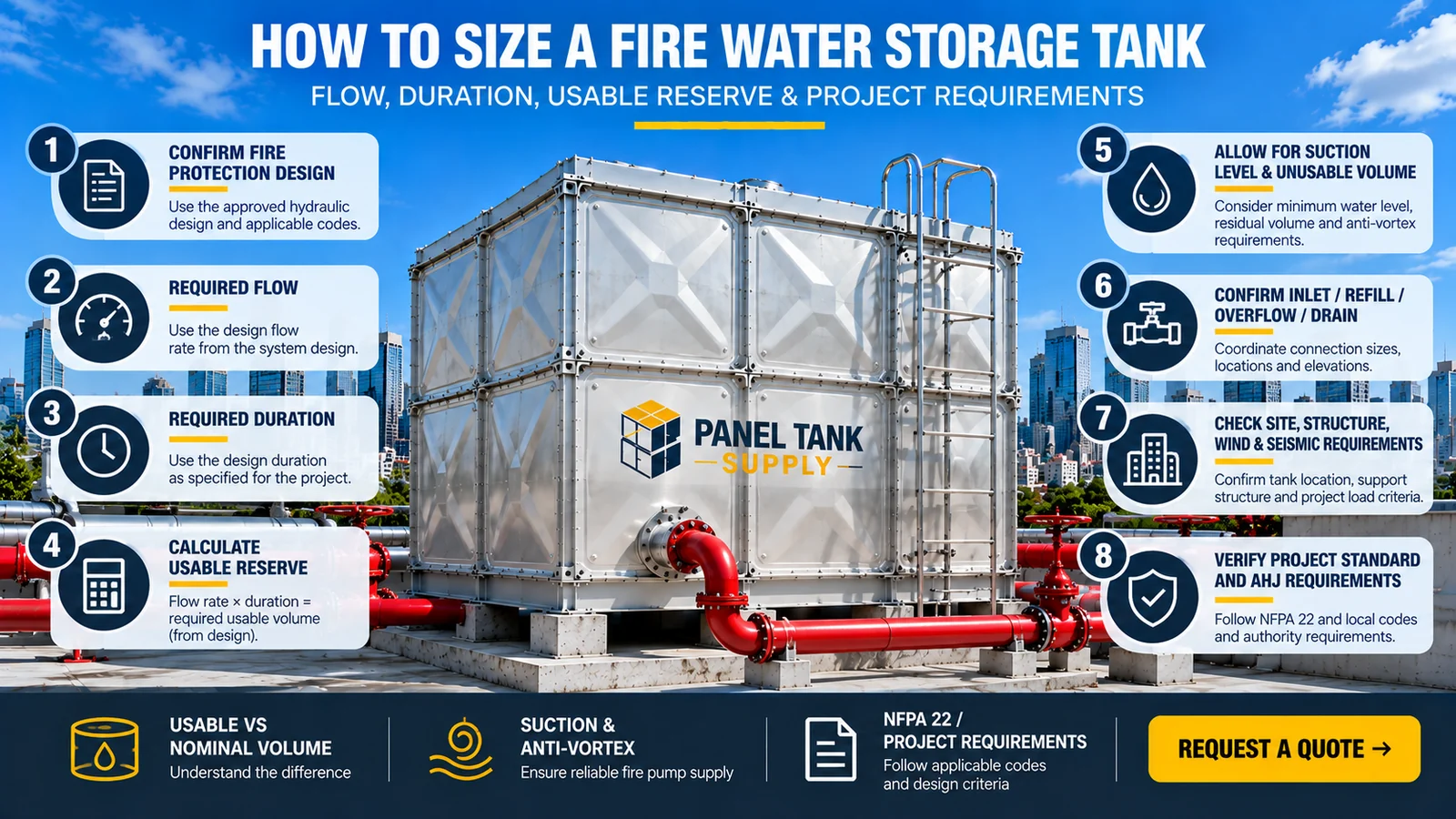
    A fire water storage tank should be sized from the approved fire-protection design, not from a generic building size, an online rule of thumb or the amount of space available for a tank.

    The required usable fire-water reserve normally comes from the hydraulic and fire-protection design, which establishes the system demand, required duration and other project-specific requirements.

    Once that required usable volume is known, the tank can be configured around suction level, overflow, freeboard, residual volume, refill arrangement, available site dimensions, structural loads, connections and the applicable project standards.

    For US projects, NFPA 22 is an important reference for water tanks used for private fire protection, but the project fire-protection engineer, specification and authority having jurisdiction should confirm which requirements apply to the actual installation.

    This guide explains the main considerations involved in fire water tank sizing so engineers, contractors and buyers can coordinate the correct tank configuration before requesting a quotation.

    Fire Water Tank Sizing Starts With the Approved Fire-Protection Design

    The most important rule is simple:

    Do not determine the required fire-water reserve from the tank itself.

    The fire-protection design should first establish the water requirement that the tank needs to support.

    Depending on the project, the fire system may include:

    • Automatic sprinkler systems
    • Standpipe or hose systems
    • Fire pumps
    • Hydrants
    • Water-spray systems
    • Other water-based fire-protection systems

    The applicable fire-protection designer should determine the required demand, duration and system arrangement.

    The tank supplier can then configure a tank to provide the required usable reserve.

    1. Confirm the Required Fire-Protection Flow

    The required flow should come from the approved fire-protection or hydraulic design.

    It should not be guessed from:

    • Building floor area alone
    • Tank material
    • Available plant-room dimensions
    • A generic gallons-per-square-foot assumption
    • A previous unrelated project

    The fire-protection system design determines the flow that the stored water must support.

    This design information should be confirmed before the tank capacity is finalized.

    2. Confirm the Required Duration

    Fire-water storage is also influenced by how long the required system demand must be available.

    The applicable duration should come from the fire-protection design and project requirements.

    For conceptual understanding, the required reserve is related to the approved design demand over the required operating duration.

    However, the final usable volume should always be taken from the approved project design rather than calculated independently by the tank supplier or purchaser.

    3. Required Usable Volume Is More Important Than Nominal Volume

    A fire-water tank should provide the required usable reserve.

    That is not necessarily the same as the tank’s total geometric or nominal capacity.

    Some water may be unavailable to the fire-protection system because of:

    • Minimum suction level
    • Outlet elevation
    • Anti-vortex arrangement
    • Residual water below the effective suction level
    • Freeboard
    • Overflow elevation
    • Internal tank geometry

    For this reason, a requirement for a particular usable fire reserve does not automatically mean a tank with exactly the same nominal capacity will be sufficient.

    4. Usable Capacity vs Nominal Capacity

    Term Meaning
    Nominal / geometric capacity The overall water-holding volume represented by the tank geometry or stated tank size.
    Maximum operating level The normal upper water level established by the tank and overflow arrangement.
    Minimum usable level The lowest level from which the fire-protection system can reliably use stored water.
    Residual / unusable volume Water below the effective usable level that should not automatically be counted toward the required fire reserve.
    Usable fire reserve The water volume actually available to satisfy the approved fire-protection requirement.

    The approved project requirement should therefore specify or establish the required usable reserve rather than relying only on a headline tank capacity.

    5. Confirm the Fire Pump Suction Arrangement

    The suction arrangement can directly affect usable tank volume.

    The tank configuration should be coordinated with the fire-protection designer and pump arrangement.

    Relevant information can include:

    • Suction connection size
    • Suction connection elevation
    • Fire pump arrangement
    • Minimum effective operating level
    • Anti-vortex requirements
    • Connected pipe arrangement

    The suction connection should not be treated as an ordinary outlet that can simply be positioned after the tank has already been selected.

    6. Anti-Vortex Requirements

    Fire-water suction arrangements may require measures intended to reduce vortex formation and maintain reliable water supply to the fire pump.

    The exact arrangement should follow the fire-protection design and requirements applicable to the project.

    Where an anti-vortex component is required, its geometry and position can affect the usable water level and connection details.

    This is another reason the tank supplier should receive the fire-system requirements before manufacture.

    7. Confirm the Overflow Level

    The overflow helps define the maximum normal water level inside the tank.

    The overflow arrangement should be coordinated with:

    • Maximum operating water level
    • Required freeboard
    • Tank roof
    • Fill arrangement
    • Overflow pipe diameter
    • Overflow discharge location

    The overflow level is part of the usable-capacity calculation because water above the normal overflow level cannot be relied upon as stored reserve.

    8. Confirm the Fill and Refill Arrangement

    The project design should establish how the tank is filled and what refill requirements apply.

    Relevant information may include:

    • Available incoming water supply
    • Fill connection size
    • Fill location
    • Control arrangement
    • Required refill performance
    • Project-specific fire-protection requirements

    The presence of a refill supply should not be used to reduce required stored volume unless the approved fire-protection design specifically allows that approach.

    9. Do Not Size a Fire Tank From Building Area Alone

    Building size may influence the overall fire-protection design, but it is not a substitute for a hydraulic calculation or approved system requirement.

    Two buildings of similar floor area can have different:

    • Occupancies
    • Fire hazards
    • Sprinkler designs
    • Standpipe arrangements
    • System demands
    • Required durations
    • Local approval requirements

    The fire-water tank should therefore follow the actual project fire design.

    10. NFPA 22 and Project Requirements

    NFPA 22 is an important US standard relating to water tanks for private fire protection.

    However, specifying “NFPA 22 tank” does not by itself define every project requirement.

    The complete installation can also require coordination of:

    • Required usable capacity
    • Tank type
    • Structural design
    • Suction arrangement
    • Fill arrangement
    • Overflow
    • Drain
    • Heating where required
    • Access
    • Level indication
    • Foundation
    • Project-specific accessories

    The project specification and authority having jurisdiction should be reviewed before manufacture.

    We will cover this in more detail in the dedicated guide NFPA 22 Water Tanks: What to Confirm Before Ordering.

    11. Local AHJ Requirements Matter

    The authority having jurisdiction may impose or interpret requirements that affect the fire-water system.

    Those requirements should be resolved early where they influence:

    • Tank capacity
    • Connections
    • Fire pump arrangement
    • Structural requirements
    • Access
    • Heating
    • Inspection
    • Testing
    • Project documentation

    It is much easier to resolve these requirements before tank manufacture than after a tank has been delivered.

    12. Fit the Tank to the Available Site

    Once the required usable reserve is established, the tank configuration can be developed around the available space.

    Provide:

    • Maximum available length
    • Maximum available width
    • Maximum available height
    • Indoor or outdoor installation
    • Existing walls and columns
    • Pipework
    • Access routes
    • Required maintenance clearance

    The required fire-water capacity should not be reduced simply because the initially proposed tank room is too small.

    Instead, the project team may need to review the tank proportions, tank location or overall plant arrangement.

    13. Rectangular vs Circular Fire Water Tanks

    Different modular tank systems can suit different fire-water projects.

    Rectangular Sectional Tanks

    Rectangular sectional systems can use available building floor area efficiently and may be useful in plant rooms or constrained commercial sites.

    Materials can include:

    Large Bolted Tanks

    For larger external fire-water reserves, bolted systems such as glass fused to steel tanks may also be considered depending on the project specification, capacity and site arrangement.

    The tank technology should follow the application and project requirements rather than being selected before the fire reserve is known.

    14. Fire Tank Material Selection

    Fire-water capacity and tank material are separate decisions.

    The required fire reserve should first be established by the fire-protection design.

    Then the tank material can be reviewed against:

    • Required capacity
    • Available footprint
    • Indoor or outdoor installation
    • Corrosion environment
    • Water quality
    • Restricted access
    • Project design life
    • Maintenance expectations
    • Project specifications

    There is no single tank material that is automatically correct for every fire-water project.

    15. Restricted-Access Fire Water Tanks

    Commercial buildings sometimes require significant fire-water storage inside plant rooms, basements or other locations where a complete fabricated tank cannot be delivered.

    A sectional tank can help because individual panels are transported into the space and assembled at the final tank location.

    Before selecting the configuration, check:

    • Door dimensions
    • Corridor width
    • Elevator dimensions and capacity
    • Stair access
    • Available assembly clearance
    • Working space around the tank

    See What Is a Sectional Water Tank?

    16. Confirm the Foundation and Structural Design

    A full fire-water tank can impose substantial loads on its supporting structure.

    The structural design should consider the actual tank arrangement and project location.

    Depending on the installation, inputs may include:

    • Tank operating weight
    • Hydrostatic load
    • Wind
    • Seismic requirements
    • Roof loading
    • Anchorage
    • Foundation reactions
    • Connected pipe loads

    The project structural engineer and tank supplier should coordinate the foundation interface for the selected tank.

    17. Wind and Seismic Requirements Are Site Specific

    Do not assume that one wind or seismic design applies to an entire state.

    The relevant structural criteria should be established for the actual project location and tank arrangement.

    This is particularly important for exposed outdoor tanks and projects in higher wind or seismic regions.

    18. Cold-Weather Projects

    Projects in freezing climates may require additional consideration of:

    • Water temperature
    • Tank heating where required
    • Insulation
    • Exposed pipework
    • Roof conditions
    • Maintenance access

    The applicable fire-protection design and project specification should establish any cold-weather requirements.

    19. Coordinate the Drain

    The tank drain supports emptying, maintenance and inspection.

    Confirm:

    • Drain size
    • Location
    • Connection type
    • Discharge arrangement
    • Site drainage capability

    The drain should be coordinated with the surrounding site rather than terminating without a suitable discharge plan.

    20. Level Indication and Monitoring

    Fire-water storage projects may require level indication or monitoring arrangements.

    The tank supplier should know what equipment or penetrations need to be incorporated into the tank package.

    Confirm any required:

    • Level indication
    • Low-level signals
    • High-level signals
    • Instrumentation connections
    • Control interfaces

    The exact system requirements should come from the fire-protection and controls design.

    21. Tank Capacity Should Be Confirmed Before Manufacturing

    Late capacity changes can affect almost every part of a tank project.

    A change in required usable reserve can affect:

    • Tank dimensions
    • Panel count
    • Tank height
    • Foundation loads
    • Roof arrangement
    • Connection positions
    • Freight
    • Cost

    The fire-protection design should therefore be sufficiently developed before the final tank is released for manufacture.

    22. Information to Send the Tank Supplier

    For an accurate fire-water tank quotation, provide as much of the following information as possible:

    • Required usable fire-water reserve
    • Approved fire-system design information
    • Project ZIP code and state
    • Maximum available tank dimensions
    • Indoor or outdoor location
    • Preferred tank material if specified
    • Fire suction size and location
    • Fill connection size and location
    • Overflow size and location
    • Drain size and location
    • Operating and suction levels where known
    • Access requirements
    • Level indication requirements
    • Required ladders or platforms
    • Structural design criteria
    • Applicable standards
    • AHJ requirements
    • Project specifications
    • Drawings
    • Required delivery date

    23. Common Fire Water Tank Sizing Mistakes

    Choosing the Tank Before the Fire Design Is Complete

    The required reserve should drive the tank configuration, not the other way around.

    Using Nominal Capacity as Usable Reserve

    Check suction levels, residual water, overflow and freeboard before confirming usable volume.

    Guessing the Required Duration

    Use the duration established by the approved project design.

    Ignoring the Suction Arrangement

    Fire pump suction details can affect usable water level and connection design.

    Forgetting Local Approval Requirements

    Resolve AHJ and project-specific requirements before manufacture.

    Ignoring Structural Loads

    The foundation and supporting structure need to suit the actual filled tank and project design criteria.

    How to Size a Fire Water Storage Tank: Final Answer

    A fire-water tank should be sized from the approved fire-protection requirement.

    The design should establish the required demand, duration and usable reserve. The tank supplier can then configure a tank that provides that usable water volume while accounting for suction level, residual volume, overflow, freeboard, connections and project constraints.

    Do not select the tank from building area or nominal tank capacity alone.

    For US projects, confirm the applicable NFPA 22, project specification, structural requirements and authority-having-jurisdiction requirements before manufacture.

    Once those requirements are established, the tank material, dimensions and modular configuration can be selected around the actual fire-protection project.


    Need a Fire Water Tank Sized for Your Project?

    Panel Tank Supply can review the approved fire-water requirement and site constraints and help identify a suitable modular tank configuration for quotation.

    Send the required usable reserve, project ZIP code and state, available dimensions, suction and fill requirements, overflow and drain sizes, structural criteria and any available fire-protection drawings or specifications.

    Request Fire Water Tank Pricing →


    Frequently Asked Questions

    How Do You Size a Fire Water Storage Tank?

    The required usable capacity should come from the approved fire-protection or hydraulic design. The tank is then configured around that reserve while accounting for suction level, residual volume, overflow, freeboard and site requirements.

    Can I Calculate Fire Tank Size From Building Area?

    Building area alone is not sufficient. The applicable fire-protection design should establish the system demand, required duration and usable water reserve.

    What Is the Difference Between Nominal and Usable Fire Tank Volume?

    Nominal volume describes overall tank capacity, while usable fire reserve is the water volume actually available to the fire-protection system after accounting for suction level, residual volume, overflow and other operating limits.

    Does the Fire Pump Suction Level Affect Tank Size?

    Yes. Water below the effective usable suction level should not automatically be counted toward the required usable fire reserve.

    What Is NFPA 22?

    NFPA 22 is the US standard for water tanks used for private fire protection. The applicable project requirements and edition should be confirmed with the fire-protection designer, project specification and authority having jurisdiction.

    Can GRP Tanks Be Used for Fire Water?

    GRP / FRP sectional tanks may be considered for fire-water storage where the selected system meets the project’s capacity, structural, material and fire-protection requirements.

    Can Galvanized Steel Tanks Be Used for Fire Water?

    Galvanized sectional steel tanks are commonly considered for fire-water storage where the system is suitable for the required capacity, site conditions and project specification.

    Can Glass Fused to Steel Tanks Be Used for Fire Water?

    Large bolted glass fused to steel tanks may also be considered for fire-water projects, particularly where substantial external storage capacity is required and the project specification supports that system.

    What Information Is Needed for a Fire Tank Quote?

    Provide the approved usable reserve, project location, available dimensions, suction and fill requirements, overflow, drain, tank material requirements, structural criteria, project specifications and applicable fire-protection documentation.
  • How to Size a Commercial Water Storage Tank: Step-by-Step Guide

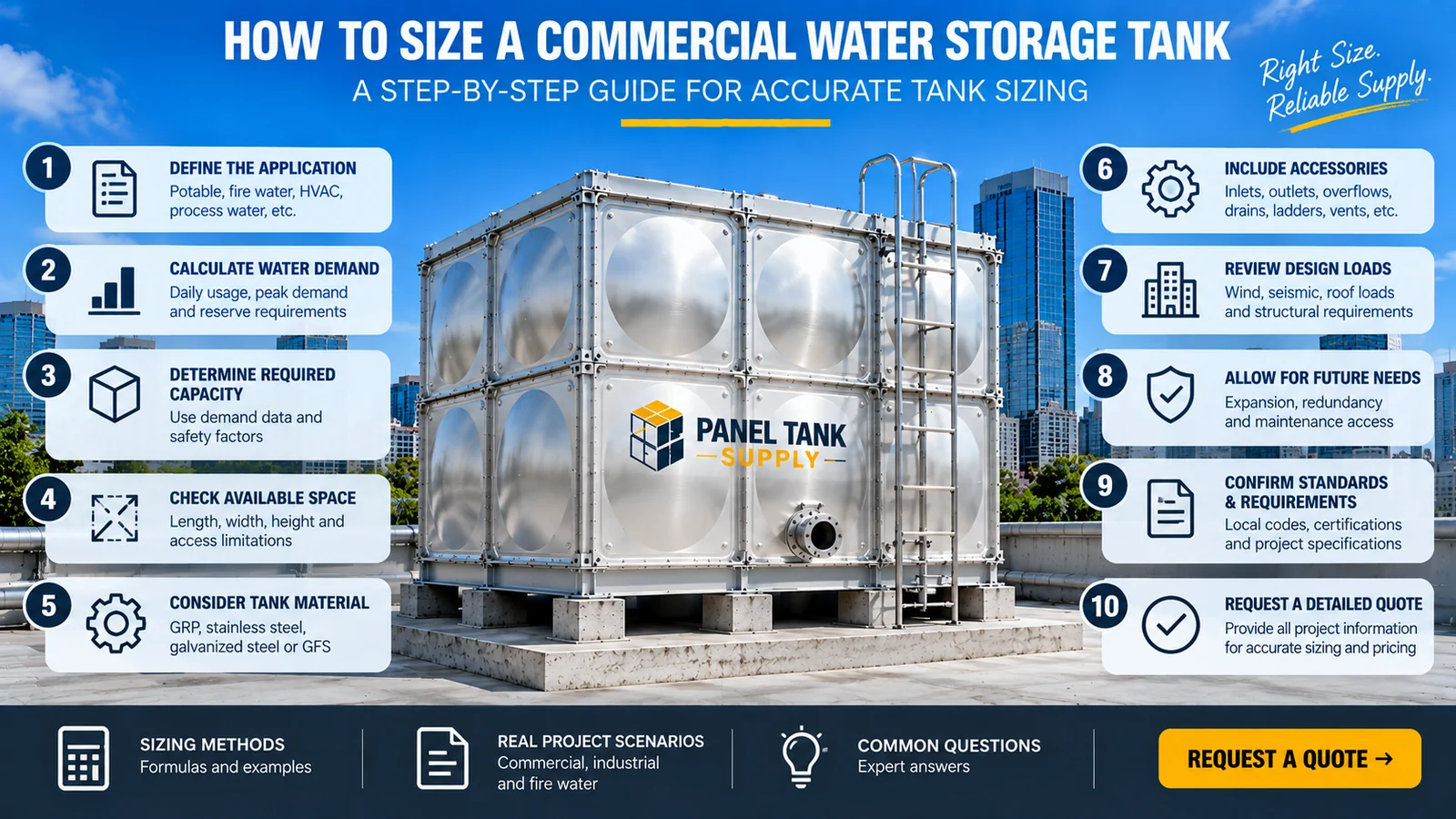
    How to Size a Commercial Water Storage Tank: Step-by-Step Guide

    Sizing a commercial water storage tank begins with one fundamental question: how much usable water does the project actually need?

    That number should come from the building-services, hydraulic, process or project design rather than from guessing a tank size based only on the available room.

    Once the required usable storage volume is known, the tank can be configured around the available footprint, height, operating water level, freeboard, connections, structural requirements, access and maintenance clearances.

    This is particularly important with modular panel water tanks, because the same required capacity may be achieved using several different combinations of length, width and height.

    This guide explains how to size a commercial water storage tank and what information engineers, contractors and buyers should confirm before requesting a tank quotation.

    Commercial Water Tank Sizing: The Basic Process

    A useful commercial tank sizing process can be broken into the following steps:

    1. Define the water-storage application
    2. Establish the required usable storage volume
    3. Confirm any required reserve
    4. Determine operating water levels
    5. Identify the available footprint and height
    6. Allow for freeboard and unusable volume
    7. Coordinate inlet, outlet, overflow and drain connections
    8. Confirm site access and assembly clearance
    9. Review structural and foundation requirements
    10. Select an appropriate tank material and configuration

    1. Start With the Water-Storage Application

    The tank should be sized around what it actually needs to do.

    Commercial water-storage applications can include:

    • Potable water storage
    • Domestic building water
    • Fire water
    • HVAC make-up water
    • Process water
    • Factory water
    • Raw water
    • Emergency reserve
    • Utility water
    • Other project-specific storage

    Different applications can have different operating requirements, reserve volumes, connections and material-selection considerations.

    A potable-water tank, for example, may have different material and certification requirements from a general industrial utility-water tank.

    See our commercial building water storage information for common building applications.

    2. Establish the Required Usable Storage Volume

    Tank sizing should begin with the required usable storage volume.

    This is different from simply choosing a nominal tank capacity.

    The required volume should come from the relevant project design.

    Depending on the application, that design may consider:

    • Expected water demand
    • Peak usage
    • Required operating reserve
    • Replenishment rate
    • Process requirements
    • Emergency reserve
    • Fire-protection requirements
    • Required operating duration

    The tank supplier should not replace the project’s hydraulic or process designer when establishing the required water demand.

    Once the required usable volume is confirmed, the tank configuration can be developed around it.

    3. Usable Volume vs Nominal Tank Volume

    One of the most important sizing concepts is the difference between nominal tank volume and usable water volume.

    A tank’s full geometric volume may not represent the amount of water that can actually be used by the system.

    Real tank arrangements may need to allow for:

    • Freeboard
    • Overflow level
    • Minimum operating level
    • Suction arrangement
    • Residual water below the usable outlet level
    • Internal structural components
    • Required reserve

    For this reason, a project requiring 10,000 gallons of usable water should not automatically be specified simply as a “10,000-gallon tank” without checking the operating arrangement.

    4. What Is Freeboard?

    Freeboard is the vertical space between the normal maximum water level and the top of the tank or relevant roof level.

    The exact requirement depends on the tank system and project design.

    Freeboard means that the tank’s complete internal geometric volume may be greater than its normal operating water volume.

    This should be considered when translating the required usable capacity into final tank dimensions.

    5. Confirm the Overflow Level

    The overflow arrangement helps establish the maximum operating water level.

    Its position should be coordinated with:

    • Required operating level
    • Freeboard
    • Inlet arrangement
    • Tank roof
    • Overflow pipework
    • Available connection locations

    Overflow requirements should be identified before tank manufacture rather than treated as an afterthought.

    6. Confirm Minimum Operating and Suction Levels

    The lowest usable water level can also affect tank sizing.

    If an outlet or suction connection cannot use all water down to the tank floor, some residual volume may remain below the effective operating level.

    This is particularly important where the project requires a defined usable reserve.

    Fire-water projects are a clear example: the required usable fire reserve and hydraulic arrangement should be established from the fire-protection design rather than from nominal tank volume alone.

    We will cover this separately in How to Size a Fire Water Storage Tank.

    7. Calculate the Approximate Geometric Volume

    For a simple rectangular tank, geometric volume can be estimated from:

    Length × Width × Water Depth

    If the dimensions are measured in feet:

    Volume in cubic feet = Length (ft) × Width (ft) × Water Depth (ft)

    One cubic foot contains approximately 7.48 US gallons.

    So:

    Approximate gallons = Length × Width × Water Depth × 7.48

    This is useful for early spatial planning, but it is not a substitute for the final manufacturer’s tank configuration.

    Actual usable volume should account for operating levels, freeboard, panel geometry, internal structure and the specific tank design.

    8. Example: Early-Stage Tank Sizing

    Imagine a project requiring approximately 15,000 gallons of usable commercial water storage.

    The project team should not immediately order a tank labelled “15,000 gallons.”

    Instead, the process should look more like this:

    1. Confirm that 15,000 gallons is the required usable volume.
    2. Establish maximum and minimum operating levels.
    3. Allow for freeboard.
    4. Confirm overflow elevation.
    5. Confirm inlet and outlet elevations.
    6. Identify the available room dimensions.
    7. Develop tank length, width and height combinations.
    8. Check access and maintenance clearance.
    9. Confirm structural support requirements.
    10. Verify the final usable capacity of the selected tank configuration.

    The final nominal tank size may therefore need to be greater than the required 15,000-gallon usable volume.

    9. Fit the Tank to the Available Space

    Once the required water volume is understood, the next major question is where the tank must fit.

    Provide the maximum available:

    • Length
    • Width
    • Height

    Also identify:

    • Columns
    • Walls
    • Pipework
    • Ductwork
    • Electrical equipment
    • Structural beams
    • Door openings
    • Maintenance zones
    • Other permanent obstructions

    The usable tank envelope is often smaller than the room dimensions themselves.

    10. Low and Wide vs Tall and Narrow Tanks

    The same approximate storage volume can often be achieved using different tank proportions.

    Low and Wide Configuration

    A lower tank may use more floor area but less height.

    This may suit projects with generous plant-room floor space but restricted ceiling height.

    Tall and Narrow Configuration

    A taller tank may use less floor area but introduce greater hydrostatic loading and different structural requirements.

    This may be useful where floor area is limited but sufficient height is available.

    The best configuration should therefore consider both space efficiency and structural design.

    11. Why Tank Height Matters

    Increasing tank height does more than simply add volume.

    Greater water depth increases hydrostatic loading on the tank structure.

    This can affect:

    • Panel thickness
    • Structural reinforcement
    • Bracing
    • Fasteners
    • Support requirements
    • Foundation loads

    The tallest tank that physically fits in a room is not automatically the best or most economical configuration.

    12. Allow for Assembly Clearance

    A tank may physically fit inside the available room but still be impossible to assemble if sufficient working clearance has not been allowed.

    Space may be required for:

    • Panel installation
    • Fastener access
    • Structural bracing
    • Roof installation
    • Ladders and access equipment
    • Pipe connections
    • Inspection
    • Future maintenance

    For restricted-access projects, provide both the final tank-room dimensions and the route the panels must travel to reach the room.

    See what is a sectional water tank? for more information on modular access.

    13. Confirm How the Tank Components Reach the Installation Area

    This is especially important in existing commercial buildings.

    The required tank may fit inside the mechanical room but the individual components still need to reach that room.

    Confirm:

    • Door widths
    • Door heights
    • Corridor widths
    • Turning areas
    • Elevator dimensions
    • Elevator capacity
    • Stair access where applicable
    • Rooftop access
    • Crane or lifting restrictions

    Sectional systems can be advantageous because the tank arrives as components rather than one complete fabricated vessel.

    14. Coordinate Inlet Size and Elevation

    The tank inlet should be identified during the sizing and configuration stage.

    Provide:

    • Connection diameter
    • Connection type
    • Preferred wall
    • Required elevation
    • Flow requirements where relevant

    Large or unusually positioned connections may affect panel selection or reinforcement.

    15. Coordinate the Outlet

    The outlet arrangement affects both hydraulic performance and the usable water volume.

    Confirm:

    • Outlet diameter
    • Connection type
    • Location
    • Elevation
    • Connected pipework arrangement

    If the outlet cannot draw water below a particular level, that residual volume should not automatically be counted as usable storage.

    16. Overflow and Drain Connections

    The overflow and drain should also be coordinated before the tank is manufactured.

    Overflow

    The overflow location influences the maximum normal water level and should work with the project drainage arrangement.

    Drain

    The drain should support tank emptying and maintenance requirements.

    Connection location, floor geometry and the surrounding drainage arrangement should be considered together.

    17. Consider Internal Bracing

    Many sectional tanks use structural reinforcement or bracing as part of the tank design.

    Internal structural components can occupy some internal space and may influence:

    • Usable water volume
    • Access
    • Cleaning
    • Connection locations
    • Inspection

    This is another reason geometric tank dimensions should not be treated as the complete sizing calculation.

    18. Roof Structure Also Matters

    The roof is part of the complete tank system.

    Depending on the product and project, roof requirements may include:

    • Roof panels
    • Roof supports
    • Access hatches
    • Vents
    • Level equipment
    • Roof penetrations
    • Ladders
    • Platforms

    The overall tank height may therefore differ from the water depth.

    When space is tight, provide the actual maximum available overall height rather than only the desired water depth.

    19. Select the Tank Material

    Once capacity and site limits are understood, material selection can be reviewed.

    Common Panel Tank Supply systems include:

    Material selection depends on more than capacity.

    Review:

    • Stored water or process liquid
    • Water chemistry
    • Corrosion exposure
    • Indoor or outdoor environment
    • Potable-water requirements
    • Maintenance expectations
    • Project specification
    • Tank geometry

    20. Commercial Potable Water Tank Sizing

    For potable-water projects, start with the required usable storage established by the building or water-system design.

    Then confirm the tank system is suitable for drinking-water service and that the required product documentation applies to the proposed configuration.

    Other considerations can include:

    • Water turnover
    • Cleaning access
    • Tank compartmentation where required
    • Water quality requirements
    • Inlet and outlet locations
    • Overflow protection

    See potable water storage tanks.

    21. Fire Water Is Sized Differently

    Commercial buildings may also require dedicated fire-water storage.

    A fire-water tank should not be sized from general building water consumption.

    The required usable fire reserve should come from the approved fire-protection or hydraulic design.

    That design may establish requirements for flow, duration, suction levels, refill, overflow, reserve volume and other system details.

    See fire water storage tanks.

    22. Consider Future Requirements Carefully

    Some projects may want to allow for future expansion, additional building demand or changes in operation.

    If future storage is required, it should be deliberately defined rather than adding an arbitrary percentage to the tank size.

    Increasing capacity can affect:

    • Footprint
    • Tank height
    • Structural loads
    • Foundation requirements
    • Material quantity
    • Cost

    Future capacity should therefore be coordinated with the project design.

    23. Confirm Foundation and Structural Support

    The completed tank and stored water can create significant structural loads.

    The supporting structure needs to be suitable for the actual tank arrangement.

    Depending on the project, structural inputs can include:

    • Filled tank weight
    • Hydrostatic loading
    • Support reactions
    • Wind
    • Seismic criteria
    • Roof loading
    • Anchorage
    • Connected pipe loads

    Structural criteria should be established for the actual project location and tank configuration.

    24. Useful Information for a Commercial Tank Sizing Request

    To develop an appropriate tank configuration, provide:

    • Required usable capacity
    • Application
    • Stored water or liquid
    • Project ZIP code and state
    • Maximum available length
    • Maximum available width
    • Maximum available overall height
    • Required operating level
    • Overflow level if known
    • Inlet size and location
    • Outlet size and location
    • Overflow size
    • Drain size
    • Indoor or outdoor location
    • Access restrictions
    • Required tank material if specified
    • Required accessories
    • Applicable standards or certifications
    • Structural criteria where available
    • Project drawings
    • Required delivery date

    25. Common Commercial Tank Sizing Mistakes

    Some common mistakes can make tank selection more difficult later in the project.

    Using Nominal Capacity as Usable Capacity

    Always confirm operating levels, freeboard and any unusable residual volume.

    Selecting Dimensions Before Confirming Demand

    Start with required storage and then fit the tank to the site.

    Ignoring Assembly Clearance

    A tank that fits mathematically may still need additional room for assembly and maintenance.

    Leaving Connections Until Late

    Large or unusual nozzles can influence panel and structural details.

    Ignoring the Access Route

    The tank room is only part of the problem. Components must also reach it.

    Forgetting the Foundation

    The final tank configuration needs to be coordinated with its supporting structure.

    How to Size a Commercial Water Storage Tank: Final Answer

    Commercial water tank sizing should begin with the required usable storage volume, not with a guessed tank dimension.

    Once the required water volume is confirmed, develop the tank configuration around operating levels, freeboard, available footprint, height, connections, access, structural support and the selected tank material.

    The same required capacity may be achieved through several different tank configurations, but each configuration can have different structural, cost and installation implications.

    The most useful approach is to provide the project requirements and available site dimensions so a suitable modular tank configuration can be developed around the actual job.


    Need This Tank Sized for a Commercial Project?

    Panel Tank Supply can review your required capacity and site limitations and help identify a suitable modular water tank configuration for quotation.

    Send the usable storage requirement, project ZIP code and state, available dimensions, application, connection schedule, access information and any project drawings or specifications.

    Request Commercial Tank Sizing & Pricing →


    Frequently Asked Questions

    How Do You Size a Commercial Water Storage Tank?

    Start with the required usable storage volume established by the project design. Then account for operating levels, freeboard, available dimensions, connections, access, structure and the selected tank configuration.

    What Is the Difference Between Nominal and Usable Tank Capacity?

    Nominal capacity generally describes an overall tank volume, while usable capacity is the water volume actually available to the system after considering operating levels, freeboard, suction levels and any residual volume.

    How Do You Calculate Gallons in a Rectangular Water Tank?

    For preliminary calculations using feet, multiply length by width by water depth to obtain cubic feet, then multiply by approximately 7.48 to convert cubic feet to US gallons. Final usable tank capacity should be verified against the actual tank design.

    Should I Choose Tank Dimensions Before Calculating Water Demand?

    No. The required storage volume should normally be established first. Tank dimensions can then be developed around the available site space and structural requirements.

    Does Tank Height Affect the Structural Design?

    Yes. Greater water depth increases hydrostatic loading and can affect panel thickness, reinforcement, bracing, support and foundation requirements.

    How Much Space Should Be Left Around a Panel Tank?

    Clearance requirements depend on the selected tank system. Space may be needed for assembly, fasteners, bracing, roof construction, pipe connections, inspection and future maintenance.

    Can a Commercial Water Tank Be Installed Inside an Existing Building?

    Sectional tanks can be well suited to existing buildings because individual components can be transported through constrained access routes and assembled at the final location, subject to sufficient access and working space.

    Can the Tank Supplier Determine My Required Water Demand?

    The required demand or reserve should generally come from the relevant building-services, hydraulic, process or fire-protection design. The tank supplier can then configure a tank around that required usable volume.

    What Information Should I Send for Tank Sizing?

    Provide required usable capacity, application, project location, available length, width and height, operating levels if known, connection requirements, access restrictions, structural criteria and any available project drawings or specifications.

  • How Much Does a Modular Water Tank Cost? Complete Pricing Guide

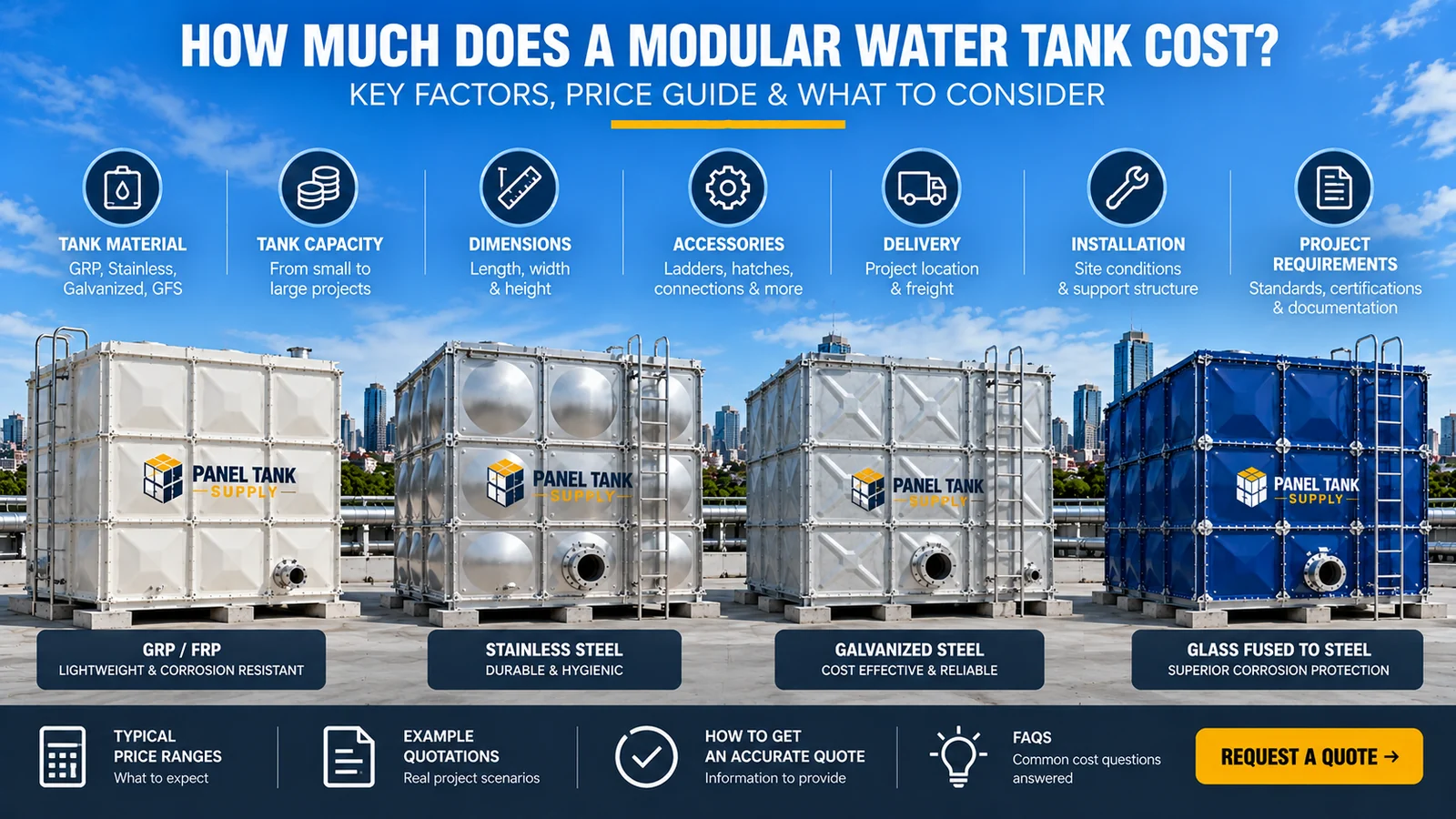
    How Much Does a Modular Water Tank Cost? Complete Pricing Guide

    There is no reliable single price for every modular water tank.

    The cost of a panel water tank depends on much more than storage capacity. Material, tank dimensions, height, structural requirements, roof design, connections, accessories, project location, freight and documentation can all change the final supply price.

    This is why two tanks with the same nominal capacity can have noticeably different quotations.

    A low, wide tank may require a different structural arrangement from a tall, narrow tank. A simple clean-water tank can also have a very different scope from a project requiring large nozzles, special coatings, access platforms, certification or higher wind and seismic design loads.

    This guide explains the main factors that affect modular water tank cost and the information buyers should provide to receive a useful project-specific quotation.

    Can You Price a Modular Tank by the Gallon?

    Price-per-gallon figures can be useful as a very rough comparison tool, but they are not a reliable way to define the actual cost of an engineered modular tank.

    Two tanks can hold the same volume while having completely different:

    • Materials
    • Lengths
    • Widths
    • Heights
    • Panel arrangements
    • Structural reinforcement
    • Roof systems
    • Connections
    • Accessories
    • Engineering requirements
    • Freight costs

    For this reason, project pricing should be based on an actual tank configuration rather than capacity alone.

    Main Factors That Affect Modular Water Tank Cost

    Cost Factor Why It Matters
    Tank material GRP / FRP, stainless steel, galvanized steel and GFS use different materials and manufacturing systems.
    Capacity Larger storage generally requires more panels, structure and components.
    Tank dimensions Length, width, diameter and height influence the complete structural configuration.
    Tank height Greater water depth increases hydrostatic loading and can change structural requirements.
    Structural design Bracing, panel thickness and supports depend on the selected system and design loads.
    Roof system Roof type, access hatches, vents and project loads can change the supply scope.
    Connections Quantity, size, position and type of nozzles or fittings affect manufacturing.
    Accessories Ladders, platforms, level indicators, insulation and other options add scope.
    Coating or grade Material grades and specialist coating requirements can affect price.
    Engineering Wind, seismic, structural and project-specific criteria can change the tank design.
    Documentation Drawings, certifications, testing or project submittals may form part of the scope.
    Freight Project ZIP code, package size, weight and delivery requirements affect transport cost.

    1. Tank Material

    Material selection is one of the first major cost variables.

    Panel Tank Supply works with several modular tank systems, including:

    These materials should not be compared only by initial panel price.

    The correct material depends on factors such as:

    • Stored water or process liquid
    • Corrosion exposure
    • Water chemistry
    • Potable-water requirements
    • External environment
    • Required capacity
    • Maintenance expectations
    • Project specifications

    The lowest-cost material is not necessarily the lowest-cost solution if it is poorly matched to the project.

    2. Tank Capacity

    Capacity clearly affects price because a larger tank generally requires more material and more structural components.

    However, cost does not increase in a perfectly linear relationship with gallons stored.

    A larger tank may sometimes use its footprint and structural arrangement more efficiently than a smaller but unusually shaped tank.

    Capacity should therefore be evaluated together with tank dimensions.

    3. Tank Height Can Have a Major Impact

    Tank height matters because water creates hydrostatic pressure.

    As the water depth increases, the structural demands on lower panels and supporting components can also increase.

    A tall tank may therefore require a different panel thickness, reinforcement arrangement or structural configuration from a shallower tank of similar capacity.

    This is one reason two equal-volume tanks can have different prices.

    4. Footprint and Geometry

    The available site space can strongly influence the tank configuration.

    Consider two projects requiring approximately the same storage volume.

    Project A may have a large floor area and allow a relatively low tank.

    Project B may have a restricted footprint and require a much taller tank.

    The required usable capacity may be similar, but the structural design can be different.

    When requesting a quote, provide:

    • Maximum available length
    • Maximum available width
    • Maximum available height
    • Any fixed obstacles
    • Required assembly clearance

    If dimensions are not yet fixed, provide the available site envelope so alternative configurations can be considered.

    5. GRP / FRP Tank Cost Factors

    GRP / FRP sectional tanks use molded fiberglass-reinforced panels assembled into a modular rectangular system.

    Cost can be influenced by:

    • Panel configuration
    • Tank height
    • Structural reinforcement
    • Resin and product specification
    • Roof arrangement
    • Connections
    • Access components
    • Potable-water requirements where applicable
    • Freight

    GRP / FRP may be attractive where lightweight components, restricted access and resistance to conventional steel rust are important considerations.

    6. Stainless Steel Tank Cost Factors

    Stainless steel tank pricing depends partly on the stainless grade and quantity of material required.

    Common project considerations include:

    • 304 versus 316-family material
    • Water chemistry
    • Chloride exposure
    • Tank dimensions
    • Panel thickness
    • Reinforcement
    • Connections
    • Access components
    • Surface-treatment requirements

    316-family stainless generally carries a higher material cost than 304, but the more important question is which grade is appropriate for the actual water service and environment.

    See 304 vs 316 stainless steel water tanks.

    7. Galvanized Steel Tank Cost Factors

    Galvanized sectional tanks use pressed steel panels with galvanized corrosion protection.

    Pricing can be affected by:

    • Tank capacity
    • Panel thickness
    • Height
    • Structural reinforcement
    • Support requirements
    • Roof system
    • Connection sizes
    • Accessories
    • Environmental requirements
    • Freight

    Galvanized systems are commonly considered for fire-water, building-services and general industrial water duties when the selected system is suitable for the project.

    8. Glass Fused to Steel Tank Cost Factors

    Glass fused to steel tanks are commonly engineered as larger bolted steel systems.

    The quotation can depend on:

    • Required capacity
    • Tank diameter
    • Tank height
    • Stored medium
    • Coating system
    • Design loads
    • Roof arrangement
    • Ladders and platforms
    • Mixers or specialist equipment
    • Pipe penetrations
    • Testing and certification requirements
    • Freight

    For process or wastewater applications, the stored medium, pH, temperature and chemical exposure can also affect the coating specification.

    9. Connections Can Change the Price

    Connections are sometimes treated as a minor detail during early budgeting, but they can materially affect a final tank quotation.

    A tank may require:

    • Inlet
    • Outlet
    • Overflow
    • Drain
    • Fire suction connection
    • Return connection
    • Level instrumentation
    • Special process nozzles

    The quantity, diameter, location and connection type should be established as early as possible.

    A tank requiring several large specialist nozzles will generally have a different manufacturing scope from the same tank with only basic connections.

    10. Accessories Add to the Supply Scope

    Tank accessories can include:

    • Access hatches
    • Internal ladders
    • External ladders
    • Platforms
    • Handrails
    • Vents
    • Level indicators
    • Insulation
    • Roof penetrations
    • Special fittings

    These should be included in the project brief so suppliers are pricing the same scope.

    11. Wind and Seismic Design Can Affect Cost

    Structural requirements are site specific.

    A tank designed for one location should not automatically be assumed suitable for another location.

    Depending on the project, the tank design may need to consider:

    • Hydrostatic loads
    • Wind loads
    • Seismic criteria
    • Roof loads
    • Platform loads
    • Pipe loads
    • Foundation interface
    • Anchorage

    Higher or more demanding design criteria can change the structural components included in the tank package.

    12. Project Standards and Certification

    Documentation requirements should be identified during quotation rather than after an order is placed.

    Depending on the project, the supply package may need:

    • Technical data
    • General arrangement drawings
    • Material information
    • Product certifications
    • Engineering documentation
    • Testing records
    • Specific client submittals

    Only certifications applicable to the exact proposed system should be claimed or relied upon.

    13. Freight and Project Location

    Modular tanks have an important logistics advantage because they can be shipped as panels and components rather than as one completed oversized vessel.

    However, freight still affects project cost.

    Transportation can depend on:

    • Project ZIP code
    • Distance from supply point
    • Package quantity
    • Package dimensions
    • Package weight
    • Delivery restrictions
    • Unloading requirements
    • Remote-site logistics

    This is why the project ZIP code should be included in an early budget enquiry.

    14. Restricted Access Can Affect the Project Scope

    Modular tanks are particularly useful where access is constrained, but the actual access route still needs to be understood.

    Relevant information may include:

    • Door dimensions
    • Corridor width
    • Elevator dimensions and capacity
    • Stair or rooftop access
    • Crane restrictions
    • Available assembly space
    • Working clearance around the tank

    If standard panel dimensions cannot practically reach the installation location, the available tank options may change.

    See what is a sectional water tank?

    15. Does Installation Affect the Tank Price?

    When comparing quotations, make sure you understand exactly what each supplier has included.

    A tank supply package and a fully installed tank project are not necessarily the same scope.

    Check whether the quotation includes or excludes items such as:

    • Tank supply
    • Freight
    • Site unloading
    • Tank assembly
    • Foundation works
    • Crane or lifting equipment
    • Connected pipework
    • Electrical work
    • Commissioning

    Comparing two headline prices without aligning the scope can produce a misleading result.

    16. Why Two Equal-Capacity Tanks Can Cost Different Amounts

    Consider two hypothetical tanks that provide the same required storage volume.

    Tank A

    • Low, wide configuration
    • Standard connections
    • Simple roof
    • Moderate design loads
    • Easy delivery access

    Tank B

    • Tall, narrow configuration
    • Large specialist nozzles
    • Access platform
    • Higher structural design loads
    • Restricted urban delivery

    Although both tanks may store the same amount of water, their structural and supply requirements are different.

    This is why capacity alone is not enough to establish an accurate price.

    17. Budget Price vs Project Quote

    There is also a difference between an early budget and a developed project quotation.

    Early Budget

    An early budget may be based on preliminary information such as:

    • Approximate capacity
    • Preferred material
    • Approximate dimensions
    • Application
    • Project ZIP code

    Developed Quote

    A more detailed quotation can incorporate:

    • Confirmed dimensions
    • Connection schedule
    • Design criteria
    • Accessories
    • Drawings
    • Specifications
    • Required certifications
    • Delivery requirements

    The more complete the project information, the more accurately the tank package can be defined.

    18. How to Get a More Accurate Modular Water Tank Quote

    For useful pricing, provide as much of the following as possible:

    • Required storage capacity
    • Usable or operating volume where relevant
    • Water or liquid being stored
    • Preferred tank material if known
    • Available length
    • Available width
    • Maximum height
    • Project ZIP code and state
    • Indoor or outdoor location
    • Site-access restrictions
    • Inlet size and location
    • Outlet size and location
    • Overflow size and location
    • Drain requirements
    • Required accessories
    • Project standards
    • Certification requirements
    • Drawings or specifications
    • Required delivery date

    If some information is still unknown, provide what is available and identify the items that are still being developed.

    19. Should You Choose the Cheapest Tank?

    Initial supply price is important, but it should not be the only selection criterion.

    A lower-cost option may not represent better value if it does not suit:

    • The stored water
    • The site environment
    • The required design loads
    • The access conditions
    • The required service life
    • The project specification
    • The maintenance strategy

    Compare complete project-compliant tank packages rather than simply selecting the lowest headline price.

    20. How Much Does a Modular Water Tank Cost? Final Answer

    There is no reliable universal cost for a modular water tank because each project can require a different combination of material, capacity, dimensions, structure, roof, connections, accessories, engineering, documentation and freight.

    A price-per-gallon figure cannot capture all of those variables.

    The most useful approach is to provide the required capacity, site dimensions, application, water service, project location, connections and specifications so an actual tank configuration can be priced.

    This provides a much more meaningful budget than trying to apply one generic price to every modular tank project.


    Need Project-Specific Modular Water Tank Pricing?

    Panel Tank Supply can review your project requirements and prepare pricing around an appropriate modular tank configuration.

    Send the required capacity, application, project ZIP code and state, available dimensions, preferred material if known, connection requirements, required delivery date and any drawings or specifications.

    Request Project Pricing →


    Frequently Asked Questions

    How Much Does a Modular Water Tank Cost?

    There is no single reliable price because cost depends on the material, capacity, dimensions, structural requirements, connections, accessories, project location, documentation and freight.

    Can You Price a Panel Water Tank Per Gallon?

    Price per gallon can be misleading because two equal-capacity tanks can have very different geometry, structure, materials and accessories. Project-specific pricing is more useful.

    What Is the Biggest Factor Affecting Water Tank Price?

    There is no single factor. Material, capacity, tank height, footprint, structural design, connections and project requirements all work together to determine the final package.

    Does a Taller Tank Cost More?

    Tank height can influence price because increased water depth changes hydrostatic loading and can affect panel thickness, reinforcement and structural configuration.

    Does Stainless Steel Cost More Than GRP?

    Material costs differ, but a meaningful comparison requires complete project-specific tank packages. Grade, tank geometry, structure, connections and other requirements can change the relative price.

    Does Freight Affect Modular Tank Pricing?

    Yes. Freight depends on the project location, tank package, shipment size, weight and delivery requirements. Providing the project ZIP code helps develop a more realistic budget.

    Can I Get a Budget Price Before Final Drawings Are Ready?

    Often, an early budget can be developed from preliminary capacity, dimensions, application, material preference and project location. Pricing can then be refined as the project details develop.

    What Do I Need to Send for an Accurate Quote?

    Provide capacity, application, project location, available dimensions, water service, connections, required accessories, design requirements, delivery date and any available drawings or specifications.

  • What Is a Sectional Water Tank? Complete Guide to Panel Water Storage

    What Is a Sectional Water Tank? Complete Guide to Panel Water Storage

    A sectional water tank is a water-storage system assembled from multiple prefabricated panels or sections rather than being manufactured and delivered as one complete vessel.

    The individual panels are transported to the project site and mechanically assembled to create the required tank capacity and dimensions.

    This makes sectional water tanks particularly useful for commercial buildings, plant rooms, basements, rooftops and other restricted-access locations where a large one-piece tank may be difficult or impossible to move into position.

    Common sectional tank materials include GRP / FRP, stainless steel and galvanized steel.

    This guide explains what a sectional water tank is, how it differs from a one-piece tank, where sectional tanks are used and what buyers should confirm before ordering.

    How Is a Sectional Water Tank Constructed?

    A sectional tank is manufactured as a set of repeatable panels and related structural components.

    Depending on the selected tank system, the complete package can include:

    • Wall panels
    • Floor panels or floor system components
    • Roof panels or covers
    • Bolts and fasteners
    • Seals and gaskets
    • Internal or external reinforcement
    • Structural supports
    • Inlet connections
    • Outlet connections
    • Overflow connections
    • Drain connections
    • Access hatches
    • Ladders
    • Vents
    • Level indication
    • Other project-specific accessories

    The tank components are delivered to the installation site and assembled according to the manufacturer’s design and installation requirements.

    What Is the Main Advantage of a Sectional Tank?

    The biggest practical advantage is that a large finished tank does not have to be transported to the installation location as one piece.

    Instead, the tank arrives in manageable components.

    This can make sectional storage particularly useful where site access is restricted by:

    • Door openings
    • Corridors
    • Elevators
    • Basement access
    • Existing building structures
    • Rooftop lifting restrictions
    • Plant-room layouts
    • Restricted loading areas

    The individual components can be moved to the tank location before the complete structure is assembled.

    Sectional Water Tank vs One-Piece Water Tank

    Consideration Sectional Water Tank One-Piece Tank
    Delivery Delivered as panels and components Delivered largely or completely assembled
    Site access Well suited to restricted access Requires sufficient access for the complete tank
    Size flexibility Can be configured using modular panel arrangements Limited to available manufactured vessel sizes
    Indoor installation Often practical because components are assembled in place Can be difficult for large vessels
    Transport Components can be packed for shipment Large completed tanks may require oversized transport
    Future service Panels, seals and accessories form part of a serviceable modular system Service approach depends on the vessel design
    Material choices GRP / FRP, stainless steel, galvanized steel and other modular systems Varies by manufacturer and vessel type

    The best approach depends on tank capacity, site access, available footprint, material requirements and project constraints.

    Is a Sectional Tank the Same as a Modular Panel Tank?

    The terms are closely related and are sometimes used interchangeably.

    A modular panel water tank is a broad description for tanks built from prefabricated components.

    A sectional water tank commonly refers to rectangular tanks constructed from repeatable wall, floor and roof sections.

    GRP / FRP, stainless steel and galvanized steel systems are commonly described as sectional panel tanks.

    Large circular bolted systems such as glass fused to steel tanks are also modular, but they are not always described as sectional tanks in the same way as rectangular panel systems.

    For a broader explanation, see what is a modular panel water tank?

    What Materials Are Sectional Water Tanks Made From?

    Different sectional materials suit different water-storage requirements.

    GRP / FRP Sectional Tanks

    GRP / FRP tanks use fiberglass-reinforced composite panels assembled into a rectangular modular tank.

    They can be attractive where relatively lightweight components, resistance to conventional steel rust and restricted-access installation are important.

    Explore GRP / FRP panel water tanks.

    Stainless Steel Sectional Tanks

    Stainless sectional tanks use pressed stainless-steel panels assembled into the required tank configuration.

    Stainless steel can provide a durable, cleanable surface for potable-water, process-water and commercial-building applications where the selected grade is suitable for the service and environment.

    Common grades can include 304 and 316L.

    Explore stainless steel panel water tanks.

    Galvanized Steel Sectional Tanks

    Galvanized sectional tanks use pressed steel panels protected by a galvanized zinc coating.

    The external-flanged modular format is commonly considered for fire water, commercial building services, factory water and other general utility applications.

    Explore galvanized steel panel water tanks.

    Where Are Sectional Water Tanks Used?

    Sectional tanks can be used for a broad range of commercial and industrial water-storage applications.

    Commercial Building Water Storage

    Commercial buildings may require stored water for domestic services, building systems, emergency storage or other applications.

    Sectional construction can be particularly useful where the available plant-room dimensions are known but the access route is too small for a complete tank.

    See commercial building water tanks.

    Fire Water Storage

    Sectional tanks can be used for dedicated fire-protection water storage when the tank system meets the requirements of the project design.

    The required usable storage volume should be established from the fire-protection design before selecting the tank configuration.

    See fire water storage tanks.

    Potable Water Storage

    Sectional tanks may also be used for drinking-water storage where the specific system and wetted materials meet the required project and certification requirements.

    Material suitability should be confirmed for the actual supplied system.

    See potable water storage tanks.

    Industrial Water Storage

    Industrial facilities may use sectional tanks for process water, utility water, factory water, washdown water, raw water or other general storage duties.

    The stored liquid, water chemistry, temperature and operating environment should influence material selection.

    See industrial water storage tanks.

    Why Are Sectional Tanks Useful Inside Existing Buildings?

    Existing buildings are one of the strongest applications for sectional tank construction.

    A building may contain enough floor area for the required tank but still have no access route large enough for a complete vessel.

    For example, a tank may need to be installed:

    • Inside a basement plant room
    • Behind existing walls
    • Inside a high-rise mechanical floor
    • On a rooftop
    • Inside a hospital plant area
    • Inside a hotel mechanical room
    • Inside an existing factory

    Because the tank arrives in separate components, the panels can potentially pass through the available route before assembly.

    The access route still needs to be surveyed carefully. Panel dimensions, component weights, turning space, lifting requirements and working clearance all matter.

    Can a Sectional Tank Be Built to Fit a Specific Space?

    One of the benefits of sectional construction is dimensional flexibility.

    The tank configuration can often be developed around:

    • Required capacity
    • Available length
    • Available width
    • Maximum height
    • Panel dimensions
    • Structural requirements
    • Connection locations
    • Assembly clearance

    This means the same required capacity may sometimes be achieved using different tank proportions.

    For example, one project may favor a lower, wider tank while another may require a narrower, taller configuration.

    However, dimensional flexibility has structural limits. The final configuration needs to be engineered for the selected tank system.

    How Is a Sectional Water Tank Delivered?

    A sectional tank is normally shipped as a package of panels and related components rather than as one complete oversized vessel.

    This can simplify transportation and make long-distance delivery more practical.

    Freight planning should consider:

    • Project ZIP code and state
    • Package sizes
    • Package weights
    • Delivery vehicle access
    • Site unloading
    • Temporary storage
    • Protection of tank components before assembly

    Providing the project location during the quotation stage helps establish the expected freight scope.

    How Is a Sectional Water Tank Installed?

    The installation sequence depends on the selected tank system.

    At a high level, the process can include:

    1. Confirming the supporting structure is ready
    2. Receiving and checking the tank components
    3. Organizing panels and structural components
    4. Assembling the floor or base arrangement
    5. Installing wall panels
    6. Installing reinforcement or bracing
    7. Completing roof components
    8. Installing connections and accessories
    9. Checking seals, fasteners and alignment
    10. Completing the required inspection and commissioning process

    The actual installation should follow the documentation supplied for the selected tank system.

    How Much Clearance Is Needed Around a Sectional Tank?

    There is no single clearance dimension that applies to every system.

    Working space may be required for:

    • Panel assembly
    • Fastener access
    • Structural bracing
    • Roof assembly
    • Pipe connections
    • Inspection
    • Future maintenance

    Before ordering, provide the available tank-room dimensions and any fixed obstacles around the proposed tank location.

    What Foundation Does a Sectional Tank Need?

    A sectional tank requires a suitable supporting structure capable of carrying the filled operating load.

    The exact support geometry depends on the tank material and design.

    Important considerations can include:

    • Tank weight when full
    • Support spacing
    • Levelness
    • Tank flange or base support requirements
    • Concrete or steel support structure
    • Anchorage where required
    • Wind loading
    • Seismic criteria

    The support arrangement should be confirmed for the actual tank rather than assuming one foundation detail is suitable for every sectional system.

    What Connections Are Required?

    Most sectional tanks require several connections that should be coordinated before manufacture.

    These can include:

    • Inlet
    • Outlet
    • Overflow
    • Drain
    • Fire suction connection
    • Return connection
    • Level instrumentation
    • Special process fittings

    Connection requirements should include size, position and any relevant flange or fitting standard.

    Pipework should be supported appropriately so excessive external loads are not transferred into the tank connection.

    Can Sectional Tanks Have Compartments?

    Some sectional systems can be configured with compartmentation where the selected design supports it.

    Compartments may be useful where a project requires operational redundancy or needs part of the tank to remain available while another section is inspected or maintained.

    The required compartment arrangement should be identified during the design and quotation stage.

    Are Sectional Water Tanks Easy to Maintain?

    The modular nature of a sectional tank can provide a serviceable system, but maintenance is still required.

    Inspection may include:

    • Panels
    • Panel joints
    • Seals and gaskets
    • Bolts and fasteners
    • Internal reinforcement
    • External supports
    • Roof components
    • Access equipment
    • Pipe connections
    • Overflow and drain arrangements

    The inspection and maintenance program should follow the requirements applicable to the exact tank system and water service.

    How Long Does a Sectional Water Tank Last?

    There is no one service-life figure that applies to every sectional tank.

    Longevity depends on factors such as:

    • Tank material
    • Water chemistry
    • External environment
    • Installation quality
    • Structural loading
    • Seal condition
    • Coating condition where applicable
    • Inspection and maintenance

    Material should therefore be selected for the actual project conditions rather than from a generic lifespan claim.

    How Much Does a Sectional Water Tank Cost?

    There is no universal price for a sectional tank because the complete tank package changes from project to project.

    Cost can be influenced by:

    • Tank material
    • Storage capacity
    • Tank dimensions
    • Tank height
    • Panel configuration
    • Structural reinforcement
    • Roof type
    • Connection sizes
    • Accessories
    • Certification requirements
    • Project documentation
    • Freight destination

    Two sectional tanks with the same capacity can have different prices if their geometry or specifications are different.

    Sectional vs Modular: Which Term Should You Use?

    For many rectangular panel-tank projects, either term may appear during procurement.

    If you are searching for suppliers, useful terms include:

    • Sectional water tank
    • Panel water tank
    • Modular water tank
    • Sectional panel tank
    • GRP sectional tank
    • Stainless steel sectional tank
    • Galvanized sectional tank

    What matters most is not the terminology but whether the proposed system meets the project requirements.

    What Information Should You Provide for a Quote?

    A useful quotation should start with a clear project brief.

    Provide:

    • Required usable capacity
    • Stored water or liquid
    • Project ZIP code and state
    • Available tank length
    • Available tank width
    • Maximum tank height
    • Indoor or outdoor installation
    • Access restrictions
    • Inlet requirements
    • Outlet requirements
    • Overflow requirements
    • Drain requirements
    • Required accessories
    • Foundation or support information where available
    • Applicable standards
    • Required certifications
    • Project drawings
    • Required delivery date

    What Is a Sectional Water Tank? Final Answer

    A sectional water tank is a storage tank assembled from multiple prefabricated panels or sections at the project site.

    The sectional approach allows large tanks to be transported in manageable components, configured around available space and installed in locations where moving a complete one-piece tank would be difficult.

    Common sectional systems include GRP / FRP, stainless steel and galvanized steel panel tanks.

    They can be used for commercial building water, potable water, fire water, process water and other industrial applications when the selected system is suitable for the project.

    For successful procurement, confirm the required capacity, material, available dimensions, site access, foundation, connections, environmental conditions and project specifications before ordering.


    Need a Sectional Water Tank for Your Project?

    Panel Tank Supply can review your project requirements and help identify an appropriate sectional tank system for quotation.

    Send us your required capacity, water application, project ZIP code and state, available tank dimensions, access restrictions, connection requirements and any drawings or specifications.

    Request a Sectional Water Tank Quote →


    Frequently Asked Questions

    What Is a Sectional Water Tank?

    A sectional water tank is assembled from individual prefabricated panels or sections at the installation site rather than being supplied as one complete vessel.

    What Is the Difference Between a Sectional Tank and a One-Piece Tank?

    A sectional tank arrives as separate components for site assembly, while a one-piece tank is largely or completely manufactured before delivery. Sectional construction can make large tanks easier to install in restricted-access areas.

    Is a Sectional Tank the Same as a Panel Tank?

    In many water-storage applications the terms overlap. Sectional tanks are commonly built from modular panels, so they are frequently described as sectional panel tanks or simply panel tanks.

    What Materials Are Sectional Water Tanks Available In?

    Common materials include GRP / FRP, stainless steel and galvanized steel. Each material has different corrosion, weight, hygiene, cost and environmental considerations.

    Can a Sectional Tank Be Installed in a Basement?

    Potentially yes. The ability to transport individual components through restricted routes makes sectional construction useful for basements and plant rooms, subject to sufficient panel access and working clearance.

    Can Sectional Water Tanks Be Installed on Rooftops?

    They can be used for rooftop projects where the structure, access, lifting plan, wind requirements and other project conditions are suitable for the selected tank system.

    Can Sectional Tanks Store Potable Water?

    Potentially. Potable-water suitability depends on the exact tank system, wetted materials and required certifications rather than sectional construction alone.

    Can Sectional Tanks Be Used for Fire Water?

    Yes, suitable sectional tank systems can be used for dedicated fire-water storage. The required usable capacity and hydraulic arrangement should be established from the project fire-protection design.

    Can a Sectional Tank Be Customized to Fit a Plant Room?

    Sectional construction provides dimensional flexibility, and tank configurations can often be developed around the available footprint and height. The final arrangement must remain within the structural limits of the selected system.

    What Information Is Needed for a Sectional Tank Quote?

    Provide the required capacity, stored service, project location, available dimensions, access limitations, connection schedule, foundation information where available and any relevant project drawings or specifications.

  • What Is a Modular Panel Water Tank? A Complete Buyer’s Guide

    What Is a Modular Panel Water Tank? A Complete Buyer’s Guide

    A modular panel water tank is a water-storage system built from individual factory-made panels and components that are transported to the project site and assembled into the final tank.

    Instead of manufacturing and delivering one complete oversized vessel, the tank arrives in modular sections. The panels are bolted or mechanically joined together on site to create the required capacity, footprint and height.

    This construction method makes modular panel water tanks particularly useful for commercial buildings, industrial facilities, fire-water systems, potable-water projects and restricted-access locations where transporting a complete tank into position would be difficult or impossible.

    Panel systems are available in several materials, including GRP / FRP, stainless steel, galvanized steel and glass fused to steel.

    This guide explains how modular panel tanks work, why they are used, what materials are available and what information buyers should provide before requesting a quotation.

    How Does a Modular Panel Water Tank Work?

    The basic concept is straightforward.

    Instead of one large fabricated shell, the water tank is divided into repeatable structural components.

    Depending on the tank system, the package may include:

    • Tank panels
    • Structural reinforcement
    • Roof components
    • Bolts and fasteners
    • Seals and gaskets
    • Bracing
    • Inlet connections
    • Outlet connections
    • Overflow connections
    • Drain connections
    • Access hatches
    • Ladders
    • Platforms where required
    • Vents
    • Level-indication components
    • Drawings
    • Installation information

    The components are delivered to the project location and assembled according to the selected tank system and project design.

    Once assembled, the individual panels work together to form the complete water-storage structure.

    Why Use Panels Instead of One Large Tank?

    One of the biggest advantages of panel construction is logistics.

    A large completed tank may be difficult to manufacture, transport and move into its final location as one piece.

    There may be restrictions such as:

    • Road transport dimensions
    • Building entrances
    • Door widths
    • Elevator dimensions
    • Service corridors
    • Plant-room access
    • Rooftop lifting limitations
    • Existing building structures

    A modular system divides the tank into smaller components that can be shipped efficiently and moved individually through the available access route.

    The final storage tank can then be assembled at the location where it will operate.

    What Is a Sectional Water Tank?

    The terms sectional water tank and modular panel water tank are closely related.

    A sectional tank is assembled from multiple sections or panels rather than being manufactured as one complete vessel.

    The term is particularly common for rectangular GRP, stainless steel and galvanized steel tanks used in commercial buildings, fire protection and industrial applications.

    Large bolted steel systems such as glass fused to steel tanks also use modular prefabricated construction, although their geometry and panel system may differ from traditional rectangular sectional tanks.

    Common Modular Panel Tank Materials

    There is no single material that is automatically best for every modular water-storage project.

    Material selection depends on stored water, corrosion exposure, capacity, installation environment, access, project specification, maintenance expectations and budget.

    GRP / FRP Panel Tanks

    GRP, FRP and fiberglass terminology is commonly used for composite panel water tanks.

    These systems use molded fiberglass-reinforced panels that are assembled into the required tank configuration.

    GRP / FRP can be attractive where lightweight modular components, resistance to conventional steel rust and restricted-access installation are important.

    Explore GRP / FRP panel water tanks.

    Stainless Steel Panel Tanks

    Stainless steel sectional tanks use pressed stainless panels assembled into a modular tank.

    They may be considered where cleanability, durability and corrosion performance are important design factors.

    Common stainless grades can include 304 and 316L, with the appropriate grade selected according to the stored service and environment.

    Explore stainless steel panel water tanks.

    Galvanized Steel Panel Tanks

    Galvanized sectional tanks use pressed steel panels protected by a galvanized zinc coating.

    The modular external-flanged format can be suitable for fire water, commercial building services, factory water and other general water-storage duties when the system matches the application.

    Explore galvanized steel panel water tanks.

    Glass Fused to Steel Tanks

    Glass fused to steel, or GFS, uses factory-coated steel panels with a vitrified glass-based coating bonded to the steel.

    GFS systems are commonly supplied as bolted circular tanks and can be particularly useful for larger-capacity municipal, industrial, process-water and wastewater applications.

    Explore glass fused to steel bolted tanks.

    Modular Panel Tank Materials: Quick Comparison

    Material Typical Construction Key Considerations
    GRP / FRP Molded fiberglass-reinforced sectional panels Lightweight handling, corrosion behavior, resin specification and water-service requirements
    Stainless Steel Pressed stainless steel sectional panels Grade selection, chloride exposure, hygiene and environment
    Galvanized Steel Pressed steel sectional panels with galvanized protection Water service, external exposure, support geometry and coating condition
    Glass Fused to Steel Factory-coated bolted steel panels Large-capacity storage, coating specification, process duty and project design

    Can Modular Panel Tanks Be Made to Different Sizes?

    Yes. One of the main advantages of modular construction is the ability to configure the tank around project requirements.

    The required capacity can often be achieved through different combinations of:

    • Tank length
    • Tank width
    • Tank diameter for relevant systems
    • Tank height
    • Panel arrangement
    • Compartmentation where supported by the selected system

    This flexibility can be valuable when a project has a fixed plant-room footprint or height limitation.

    However, not every dimension is interchangeable.

    Tank height, geometry and panel arrangement affect structural loading and may influence panel thickness, reinforcement and foundation requirements.

    How Is Tank Capacity Determined?

    Tank capacity should begin with the actual water-storage requirement rather than simply choosing the largest tank that fits the available space.

    The designer or project team should establish the required usable volume for the application.

    The required capacity may depend on factors such as:

    • Building water demand
    • Fire-protection design
    • Process-water requirements
    • Emergency reserve
    • Municipal or utility storage requirements
    • Operating water level
    • Required freeboard
    • Compartmentation

    Once the required volume is known, a tank configuration can be developed around the available footprint and height.

    Where Are Modular Panel Water Tanks Used?

    Modular water tanks can be used across a broad range of building, commercial, industrial and infrastructure applications.

    Commercial Buildings

    Hotels, hospitals, apartment buildings, schools, offices and high-rise developments may require water storage inside mechanical rooms, basements, rooftops or dedicated tank rooms.

    Sectional construction can help where available access prevents the installation of a complete one-piece vessel.

    See commercial building water tanks.

    Potable Water

    Modular tanks may be used for drinking-water storage when the specific tank system, wetted materials and applicable certifications are suitable for the application.

    See potable water storage tanks.

    Fire Water

    Panel tanks are also widely considered for dedicated fire-protection water storage.

    The required usable fire-water capacity and hydraulic arrangement should be established from the fire-protection design before the tank is selected.

    See fire water storage tanks.

    Industrial Water

    Manufacturing facilities and industrial sites may use modular tanks for process water, utility water, washdown water, raw water and other storage duties.

    The stored liquid and operating environment should guide material and coating selection.

    See industrial water storage tanks.

    Municipal and Infrastructure Storage

    Larger bolted systems may also be considered for municipal, infrastructure and utility projects requiring substantial storage capacities.

    See municipal water storage tanks.

    Why Modular Tanks Work Well for Restricted Access

    Restricted access is one of the strongest reasons to consider a sectional water tank.

    Imagine a large mechanical room inside an existing building.

    The room may have enough space for a 20,000-gallon water tank, but there may be no way to move a complete 20,000-gallon vessel through the building.

    A modular tank approaches the problem differently.

    The panels and structural components are transported through the available route individually and the tank is assembled inside the final location.

    This can make modular construction useful for:

    • Basements
    • Rooftops
    • High-rise plant rooms
    • Mechanical rooms
    • Existing buildings
    • Replacement tank projects
    • Sites with restricted crane access
    • Locations with narrow delivery routes

    How Are Modular Panel Tanks Shipped?

    Because the completed tank is divided into individual panels and components, modular systems can be packaged for transportation instead of moving one oversized vessel.

    The exact package depends on tank material and configuration.

    Project freight planning should consider:

    • Project ZIP code and state
    • Package dimensions
    • Package weight
    • Site unloading arrangements
    • Delivery access
    • Storage before assembly
    • Lifting equipment

    For US projects, providing the delivery ZIP code during quotation helps establish realistic freight requirements.

    How Is a Modular Panel Tank Installed?

    The exact installation sequence varies by tank type, but the general process involves preparing the supporting structure, receiving and organizing the tank components, assembling the panels and structural system, installing connections and accessories, and completing the checks required for the selected system.

    Tank assembly should follow the installation documentation applicable to the specific product.

    The foundation or supporting structure should also be ready and suitable before tank assembly begins.

    What Foundation Does a Panel Water Tank Need?

    Foundation requirements vary with tank material, geometry, capacity and structural arrangement.

    There is no single foundation detail that should be copied across every panel tank.

    The support system needs to accommodate the full operating load of the tank and provide the geometry required by the selected tank design.

    Relevant considerations can include:

    • Tank reactions
    • Filled operating weight
    • Support spacing
    • Levelness
    • Concrete or structural steel supports
    • Wind loads
    • Seismic requirements
    • Anchorage where required

    The required support information should be confirmed for the actual tank configuration.

    What Connections Does a Modular Water Tank Need?

    A tank normally requires several hydraulic and service connections.

    Depending on the project, these may include:

    • Inlet
    • Outlet
    • Overflow
    • Drain
    • Fire suction
    • Return connection
    • Level instrumentation
    • Specialist process nozzles

    Connection size, location, elevation and orientation should be coordinated before manufacture whenever possible.

    Late changes can affect panels, reinforcement or project schedule.

    What Accessories Can Be Included?

    Depending on the selected tank system and project requirements, accessories can include:

    • Access hatches
    • Internal or external ladders
    • Platforms
    • Handrails
    • Vents
    • Level indicators
    • Insulation
    • Roof penetrations
    • Special fittings
    • Other project-specific components

    The required accessories should be identified early so they can be coordinated with the tank design.

    What Is Included in a Supply-Only Modular Tank Package?

    Panel Tank Supply operates around a supply-only modular tank model.

    The exact scope depends on the selected system and quotation, but a tank package may include panels, structural components, roof components, bracing, bolts, seals, fittings, access components, drawings and installation information.

    The project team should review the quotation carefully so there is a clear understanding of what is included and what remains within the installer, contractor or project team’s scope.

    How Much Does a Modular Panel Water Tank Cost?

    There is no reliable single price per gallon for every modular water tank.

    Two tanks with the same capacity can have different costs because their geometry, material, structural requirements and accessories are different.

    Important pricing factors include:

    • Tank material
    • Required capacity
    • Tank height
    • Tank footprint
    • Panel configuration
    • Structural reinforcement
    • Roof design
    • Connection sizes
    • Accessories
    • Coating requirements
    • Documentation
    • Project location
    • Freight

    A useful quotation therefore requires actual project information rather than capacity alone.

    What Information Should You Provide for a Quote?

    The more complete the project brief, the easier it is to compare appropriate tank systems.

    Provide:

    • Required storage capacity
    • Intended application
    • Stored water or liquid
    • Project ZIP code and state
    • Available length and width
    • Maximum available height
    • Indoor or outdoor installation
    • Access restrictions
    • Inlet size and location
    • Outlet size and location
    • Overflow requirements
    • Drain requirements
    • Required accessories
    • Applicable project standards
    • Required certifications
    • Project drawings and specifications
    • Required delivery date

    Advantages of Modular Panel Water Tanks

    Modular panel tanks can offer several practical advantages when matched correctly to the project.

    • Large storage capacity can be delivered as smaller components
    • Useful for restricted-access installations
    • Multiple material systems are available
    • Tank dimensions can be coordinated around available space
    • Components can be manufactured before site assembly
    • Connections and accessories can be coordinated with the project
    • Individual components form part of a serviceable modular system
    • Suitable for commercial, industrial, potable, fire-water and infrastructure applications depending on the selected system

    What Are the Limitations?

    Modular construction does not eliminate the need for proper engineering and project coordination.

    A panel tank still requires:

    • A suitable supporting structure
    • Correct structural design
    • Sufficient assembly clearance
    • Appropriate installation procedures
    • Correct material selection
    • Coordinated pipe connections
    • Inspection and maintenance

    The tank should therefore be treated as an engineered storage system rather than simply a collection of interchangeable panels.

    What Is a Modular Panel Water Tank? Final Answer

    A modular panel water tank is a water-storage tank manufactured from prefabricated panels and structural components that are transported to site and assembled into the final tank.

    The modular approach allows substantial storage capacities to be delivered efficiently, configured around available space and installed in locations where a complete one-piece vessel may be impractical.

    Common systems include GRP / FRP, stainless steel, galvanized steel and glass fused to steel.

    The correct tank depends on the required capacity, water service, project environment, access, available dimensions, structural requirements, connections, certifications and budget.

    For procurement, start with the project requirements first and then select the tank material and configuration that best match those requirements.


    Need a Modular Panel Water Tank for Your Project?

    Panel Tank Supply can review your project requirements and identify suitable modular tank systems for quotation.

    Send the required capacity, application, project ZIP code and state, available dimensions, connection requirements, required delivery date and any relevant drawings or specifications.

    Request a Modular Panel Water Tank Quote →


    Frequently Asked Questions

    What Is a Modular Panel Water Tank?

    A modular panel water tank is assembled from factory-made panels and structural components rather than being manufactured and delivered as one complete vessel. The components are transported to site and assembled into the final tank configuration.

    Is a Modular Tank the Same as a Sectional Tank?

    The terms are closely related. Sectional water tanks are a type of modular tank constructed from multiple panels or sections. The term is commonly used for rectangular GRP, stainless steel and galvanized steel systems.

    What Materials Are Modular Water Tanks Made From?

    Common modular systems include GRP / FRP, stainless steel, galvanized steel and glass fused to steel. The appropriate material depends on the stored water, environment, capacity, project specification and other design requirements.

    Can a Modular Water Tank Be Installed Inside a Building?

    Yes. Sectional construction can be particularly useful inside existing buildings because the tank components can be transported separately through the available access route and assembled at the final location.

    Can Modular Tanks Store Potable Water?

    Potentially. Potable-water suitability depends on the specific tank system, wetted materials and required product certification. These requirements should be confirmed for the exact system being supplied.

    Can Modular Panel Tanks Be Used for Fire Water?

    Yes, suitable modular tank systems can be used for fire-water storage. The required usable capacity and hydraulic arrangement should be established by the fire-protection design before tank selection.

    Are Modular Water Tanks Available in Custom Sizes?

    Panelized construction allows tank configurations to be developed around a range of capacities and site dimensions, subject to the structural and dimensional limits of the selected system.

    How Are Modular Water Tanks Delivered?

    The tank is supplied as panels and related components rather than one complete oversized vessel. The package is transported to the project site for assembly.

    What Information Is Needed for a Tank Quote?

    Provide the required capacity, application, project location, available dimensions, stored water or liquid, access constraints, connection requirements, required accessories and any applicable drawings or specifications.

  • 304 vs 316 Stainless Steel Water Tanks: Which Grade Should You Choose?

    304 vs 316 Stainless Steel Water Tanks: Which Grade Should You Choose?

    Choosing between a 304 and 316 stainless steel water tank is not simply a matter of selecting the higher grade.

    Both materials can provide durable, cleanable stainless steel construction for modular water storage, but the most appropriate grade depends on the stored water, chloride exposure, external environment, cleaning chemistry, project specification and budget.

    For modular tank projects, stainless steel panel water tanks can be manufactured from sectional panels and assembled at the final installation location. This allows stainless construction to be used in plant rooms, commercial buildings and other sites where delivering one complete fabricated tank would be difficult.

    Panel Tank Supply commonly considers 304 and 316L stainless steel grades, with final grade selection based on the service and environment.

    This guide explains the main differences between 304 vs 316 stainless steel water tanks and the project conditions that should be reviewed before specifying either grade.

    What Is 304 Stainless Steel?

    304 stainless steel is a widely used stainless grade for general commercial and industrial applications.

    For water-storage projects, it may be suitable where the stored water and external environment are relatively benign and chloride exposure is controlled.

    Its corrosion-resistant surface, cleanability and durability can make it suitable for many indoor commercial, potable-water and process-water projects when the exact tank specification is appropriate for the application.

    However, the grade should still be selected from the actual service conditions rather than assuming 304 is suitable for every water source or installation environment.

    What Is 316 Stainless Steel?

    316 stainless steel belongs to a more corrosion-resistant stainless family commonly considered where chloride exposure or more demanding environmental conditions increase corrosion risk.

    In modular water-storage systems, 316L is also commonly specified. Buyers searching for “316 stainless steel tanks” should therefore confirm the exact grade proposed by the tank supplier rather than treating 316 and 316L as interchangeable specification language.

    316 or 316L may be worth considering for coastal environments, more demanding water chemistry or other applications where the additional corrosion performance is justified by the project requirements.

    304 vs 316 Stainless Steel Water Tanks: Quick Comparison

    Consideration 304 Stainless Steel 316 / 316L Stainless Steel
    Tank material Stainless steel Stainless steel
    General corrosion performance Good for many suitable water-storage environments Typically selected where greater corrosion resistance is required
    Chloride exposure More important to control and evaluate Often considered where chloride exposure is higher
    Indoor commercial use Often suitable depending on water chemistry Also suitable, though additional cost may not always be necessary
    Coastal environments Requires careful environment review Often considered with the appropriate complete specification
    Potable water Potentially suitable subject to system approval Potentially suitable subject to system approval
    Process water Application dependent Application dependent
    Cleaning chemistry Must be reviewed Must be reviewed
    Relative material cost Generally lower Generally higher
    Final selection Based on service and environment Based on service and environment

    The table is a general guide only. Final grade selection should follow the actual water chemistry, installation environment and project requirements.

    1. The Main Difference Is Corrosion Performance

    Both 304 and 316 stainless steels are designed to resist corrosion, but they do not perform identically in every environment.

    The key practical difference for tank buyers is that the 316 family generally provides improved resistance in environments where chlorides or more aggressive conditions are present.

    This does not mean 316 should automatically be specified for every project.

    If the stored water, external environment and cleaning regime are suitable for 304, the additional cost of 316 may provide little practical value.

    Conversely, using 304 purely to reduce initial cost can be a false economy if the project environment actually requires a more corrosion-resistant grade.

    2. Chloride Exposure Matters

    Chlorides are one of the most important factors when selecting a stainless steel grade for water storage.

    Potential chloride exposure can come from:

    • Stored water chemistry
    • Municipal water treatment
    • Coastal air
    • Salt-laden environments
    • Cleaning products
    • Industrial process conditions
    • External contamination

    Do not select a stainless grade from tank capacity alone.

    If chloride exposure is expected, provide the relevant water-quality information and environmental conditions during the quotation stage so the material specification can be reviewed.

    3. 304 Stainless Steel for Commercial Water Storage

    304 stainless steel can be an effective option for many commercial water-storage projects when the operating conditions are appropriate.

    Typical situations where 304 may be worth considering include:

    • Indoor plant rooms
    • Commercial building services
    • Clean-water storage
    • Controlled environments
    • Projects with relatively low chloride exposure
    • Applications where stainless construction and cleanability are important

    For commercial-building installations, modular sectional construction can also simplify access because individual panels can be transported to the tank location before assembly.

    See our guidance on commercial building water storage tanks.

    4. When 316 or 316L May Be Worth Considering

    316 or 316L stainless steel may be worth evaluating when the project involves more demanding corrosion conditions.

    Examples can include:

    • Higher chloride exposure
    • Coastal environments
    • More demanding water chemistry
    • Selected process-water applications
    • Industrial environments
    • Cleaning regimes that place greater demands on the material
    • Projects where the specification explicitly requires 316 or 316L

    This does not mean that every coastal or industrial project automatically requires 316.

    The full environment and project specification should still be reviewed.

    5. What Is 316L?

    Tank specifications and product documentation may refer to 316L rather than simply 316.

    For procurement purposes, the important point is to confirm the exact stainless steel grade that forms part of the proposed tank system.

    If the project engineer or specification requires 316L, do not accept a generic description such as “316 stainless” without confirming that the supplied material matches the required grade.

    Likewise, tank panels are only part of the system. Fasteners, bracing, nozzles, access components and other relevant materials should be coordinated with the overall tank material strategy.

    6. Potable Water Applications

    Stainless steel is commonly considered where hygiene and cleanability are important design drivers.

    Both 304 and 316-family systems may potentially be used for potable-water storage depending on the exact product configuration, water chemistry and required approvals.

    The grade alone does not establish potable-water compliance.

    The complete wetted system should be considered, including:

    • Tank panels
    • Seals and gaskets
    • Internal fasteners
    • Bracing
    • Inlet and outlet components
    • Other wetted fittings

    Applicable product certification should be confirmed for the actual supplied system.

    Learn more about potable water storage tanks.

    7. Coastal Environments

    Coastal installations deserve particular attention because airborne salts and other environmental conditions can increase corrosion exposure.

    A stainless tank located close to the coast can experience external exposure even if the stored water itself has relatively low chloride content.

    For this reason, the grade-selection process should consider both:

    • The internal stored service
    • The external installation environment

    316 or 316L may be considered where the project conditions justify the additional corrosion performance.

    However, the actual location, exposure and complete tank material strategy should still be reviewed rather than relying on a simple rule such as “coastal means 316.”

    8. Cleaning Chemistry

    Cleaning procedures can also influence stainless steel grade selection.

    This is particularly important for food, beverage, pharmaceutical and selected process-water applications where tanks may be subject to controlled cleaning programs.

    Before selecting the grade, identify:

    • Cleaning chemicals
    • Concentration
    • Temperature
    • Contact time
    • Cleaning frequency
    • Rinsing procedure

    Cleaning chemistry should be considered together with the stored medium and external environment.

    9. Surface Treatment and Passivation

    The performance of a stainless steel tank depends on more than the grade name.

    Manufacturing details and surface treatment can also be important.

    Depending on the system, welded stainless components may require appropriate cleaning or passivation following fabrication.

    When reviewing a proposal, ask what surface treatment applies to the finished tank components and how fabrication areas are handled.

    10. Fasteners, Bracing and Accessories

    A stainless steel tank is a complete assembly rather than only a set of stainless panels.

    Other components may include:

    • Fasteners
    • Internal or external bracing
    • Inlet nozzles
    • Outlet nozzles
    • Overflow connections
    • Drain connections
    • Access hatches
    • Ladders
    • Level-indication equipment
    • Connected pipework

    These components should be selected to suit the overall tank material strategy.

    Connected piping should also be independently supported and compatible with the tank system rather than imposing uncontrolled loads on tank penetrations.

    11. Restricted-Access Installation

    Both 304 and 316 stainless steel sectional tanks can provide the installation advantages of modular construction.

    Instead of transporting one complete tank, pressed stainless steel panels can be delivered as individual components and assembled at the final location.

    This makes stainless sectional tanks particularly useful for:

    • Basements
    • Mechanical rooms
    • High-rise buildings
    • Hospitals
    • Hotels
    • Commercial developments
    • Existing buildings
    • Restricted plant rooms

    Material grade does not change the need to confirm door widths, access routes, lifting limitations, working clearance and tank-room dimensions before ordering.

    12. 304 vs 316 Stainless Steel Tank Cost

    316-family stainless steel generally carries a higher material cost than 304, but grade is only one part of the final tank price.

    Total project cost can also depend on:

    • Required capacity
    • Tank length
    • Tank width
    • Tank height
    • Panel thickness
    • Structural reinforcement
    • Roof arrangement
    • Connections
    • Accessories
    • Freight destination
    • Certification requirements
    • Engineering requirements
    • Project documentation

    The correct question is therefore not simply “How much more does 316 cost?”

    The better question is whether the additional grade cost is justified by the actual environment and design requirements.

    13. Should You Choose 316 Just to Be Safe?

    Not necessarily.

    Specifying a higher-cost grade without understanding the project conditions can add unnecessary cost.

    At the same time, selecting 304 simply because it is less expensive may create unnecessary corrosion risk if the environment actually requires greater resistance.

    The material decision should be evidence based.

    Review water chemistry, chloride exposure, cleaning conditions, external environment and project specifications first.

    14. Which Grade Is Better for Indoor Tanks?

    For an indoor commercial installation with controlled conditions and suitable water chemistry, 304 may be entirely appropriate.

    However, being indoors does not automatically remove all corrosion concerns.

    The stored water, chemicals used for cleaning, humidity, condensation and nearby process conditions should still be considered.

    If those factors create more aggressive exposure, 316 or 316L may be appropriate even though the tank is indoors.

    15. Which Grade Is Better for Process Water?

    Process-water applications require a closer review of the stored medium.

    Provide information about:

    • Water chemistry
    • Chloride content where known
    • pH
    • Temperature
    • Process chemicals
    • Cleaning chemistry
    • Expected operating conditions

    Grade selection should follow compatibility with the actual process rather than assuming that all industrial water requires the same stainless grade.

    See our industrial water storage tank guidance.

    16. 304 vs 316 vs Other Tank Materials

    Before deciding between 304 and 316, it is also worth confirming that stainless steel is the right tank material for the project in the first place.

    Depending on capacity, water service, access, budget and environmental conditions, other modular systems may also be considered.

    For example, GRP / FRP can be attractive where lightweight composite construction and resistance to conventional steel rust are priorities.

    See our guide to GRP vs stainless steel water tanks for a broader material comparison.

    17. Information to Provide Before Requesting a Stainless Steel Tank Quote

    A good project brief allows the stainless grade and tank configuration to be reviewed properly.

    Provide:

    • Required storage capacity
    • Operating level
    • Stored water or process medium
    • Water chemistry where available
    • Chloride information where relevant
    • Operating temperature
    • Cleaning chemicals where relevant
    • Indoor or outdoor installation
    • Coastal or aggressive external exposure
    • Project ZIP code and state
    • Available tank dimensions
    • Delivery and access restrictions
    • Inlet and outlet requirements
    • Overflow and drain requirements
    • Required accessories
    • Applicable standards and certifications
    • Project drawings or specifications

    304 vs 316 Stainless Steel Water Tanks: Final Comparison

    304 stainless steel can provide durable and hygienic modular water storage for many suitable commercial, potable and process-water applications where chloride exposure and the environment are controlled.

    316 or 316L stainless steel is often considered where chloride exposure, coastal conditions or more demanding water chemistry increase the need for corrosion resistance.

    Neither grade should be selected purely from price or the assumption that “higher is always better.”

    The correct grade depends on the stored service, external environment, cleaning chemistry, project specification and complete tank construction.

    For the most useful comparison, evaluate complete tank systems based on the same capacity, configuration and project requirements.


    Need Help Selecting a Stainless Steel Tank Grade?

    Panel Tank Supply can review your water-storage requirements and help identify an appropriate stainless steel sectional tank configuration for quotation.

    Send the required capacity, water application, project ZIP code and state, available dimensions, water chemistry where known, connection requirements and any project drawings or specifications.

    Request a Stainless Steel Water Tank Quote →


    Frequently Asked Questions

    What Is the Main Difference Between 304 and 316 Stainless Steel Water Tanks?

    The main practical difference is corrosion performance. 316-family stainless steel is often considered where chloride exposure or more demanding environmental conditions increase corrosion risk, while 304 may be suitable for many less aggressive applications.

    Is 316 Stainless Steel Always Better Than 304?

    Not necessarily. 316 may offer additional corrosion resistance, but the additional cost may not be required for every project. Grade selection should be based on water chemistry, chloride exposure, external environment and the project specification.

    What Is the Difference Between 316 and 316L for Water Tanks?

    Tank specifications may call for 316L specifically rather than a generic 316 description. Buyers should confirm the exact grade proposed by the supplier and ensure it matches the project specification.

    Is 304 Stainless Steel Suitable for Potable Water?

    It may be suitable for potable-water applications when the specific tank system, water chemistry, wetted materials and required certifications are appropriate for the project.

    Should Coastal Water Tanks Use 316 Stainless Steel?

    316 or 316L may be worth considering where coastal exposure increases corrosion risk, but the correct grade should be determined from the actual location, internal water service and project requirements.

    Does Chloride Content Affect Stainless Steel Tank Selection?

    Yes. Chlorides are an important material-selection factor and should be considered together with temperature, cleaning chemistry and external exposure when choosing a stainless steel grade.

    Is a 316 Stainless Steel Tank More Expensive Than 304?

    316-family material generally costs more than 304, but the final tank price also depends on capacity, dimensions, panel thickness, reinforcement, accessories, connections, freight and project requirements.

    Can Stainless Steel Panel Tanks Be Installed Inside Existing Buildings?

    Yes. Sectional construction allows individual tank panels and components to be transported to the final location and assembled on site, subject to adequate access and working clearance.

  • Glass Fused to Steel vs Epoxy Coated Tanks: Which Is Better for Your Project?

    Glass Fused to Steel vs Epoxy Coated Tanks: Which Is Better for Your Project?

    Glass fused to steel and epoxy coated tanks are two common approaches to protecting steel in factory-coated bolted storage systems.

    Both use steel as the structural base, and both can be manufactured as prefabricated panels for bolted assembly on site. The major difference is the protective coating applied to the steel.

    A glass fused to steel tank, commonly abbreviated as GFS, uses a vitrified glass coating bonded to the steel during manufacture. Epoxy coated steel tanks use an organic polymer coating system applied to prepared steel under controlled manufacturing conditions.

    Neither coating should be selected from the name alone. Buyers should compare the actual coating specification, stored liquid, operating temperature, chemical exposure, testing requirements, repair procedures, design life expectations and maintenance strategy.

    This guide compares glass fused to steel vs epoxy coated tanks and explains the main questions to ask before specifying a factory-coated bolted steel tank.

    What Is a Glass Fused to Steel Tank?

    Glass fused to steel combines structural steel with a factory-applied vitrified coating.

    During manufacturing, glass-based coating material is bonded to the prepared steel surface at elevated temperature to create a hard protective layer.

    The steel provides the structural strength of the tank while the vitrified coating acts as the corrosion-resistant barrier between the steel and the stored service.

    GFS systems are commonly supplied as prefabricated bolted panels that are transported to the project site and assembled into the final tank.

    This construction can support a broad range of diameters, heights and capacities without requiring extensive field welding of the tank shell.

    Learn more about glass fused to steel bolted tanks.

    What Is an Epoxy Coated Steel Tank?

    An epoxy coated steel tank also uses steel as its structural base, but instead of a vitrified glass layer, the steel is protected by an organic polymer coating system.

    The steel surface is prepared before the epoxy system is applied under controlled manufacturing conditions.

    Depending on the specific manufacturer and system, the coating specification can include primers, intermediate layers or finish coatings designed around the intended service.

    The completed coated panels can then be transported to the project site and mechanically assembled into the tank structure.

    Like GFS, epoxy-coated bolted construction can provide modular delivery and reduce reliance on extensive shell welding at site.

    Glass Fused to Steel vs Epoxy Coated Tanks: Quick Comparison

    Consideration Glass Fused to Steel Epoxy Coated Steel
    Structural base Steel Steel
    Protective coating Vitrified glass-based coating Organic polymer / epoxy coating
    Application Factory applied and bonded to prepared steel Factory applied to prepared steel
    Typical construction Bolted factory-coated panels Bolted factory-coated panels
    Corrosion protection Hard inorganic barrier coating Protective polymer barrier coating
    Chemical compatibility Depends on coating specification and stored service Depends on epoxy formulation and stored service
    Damage / repairs Use approved GFS repair procedure Use approved epoxy repair procedure
    Testing Project and manufacturer specific Project and manufacturer specific
    Maintenance Inspection of coating, joints and accessories Inspection of coating, joints and accessories
    Cost Project dependent Project dependent

    The table provides a high-level comparison only. The exact coating system and complete tank specification should be reviewed before making a procurement decision.

    1. The Main Difference Is the Coating Technology

    Although both tanks use steel, their corrosion-protection systems are fundamentally different.

    Glass Fused to Steel

    GFS uses an inorganic vitrified coating bonded to the steel substrate during factory manufacture.

    The result is a hard protective surface designed to separate the underlying steel from the stored medium and external environment.

    Epoxy Coated Steel

    Epoxy systems use an organic polymer coating applied over prepared steel.

    The performance of an epoxy-coated system depends on the complete coating specification rather than simply the word “epoxy.”

    Factors including surface preparation, coating build, application process, curing, edge treatment and quality-control testing can all affect the finished system.

    2. Corrosion Protection

    Both systems are designed to protect the structural steel against corrosion, but they achieve this through different coating technologies.

    GFS relies on a vitrified barrier bonded to the steel.

    Epoxy relies on a polymer coating system that creates a protective barrier over the steel surface.

    For either technology, the important question is whether the exact coating has been selected for the intended service.

    A coating suitable for clean water should not automatically be assumed suitable for every wastewater, industrial or chemical process application.

    3. Stored Liquid and Chemical Compatibility

    The stored liquid is one of the most important inputs when comparing GFS and epoxy coated tanks.

    For industrial and process applications, provide information such as:

    • Stored medium
    • Water chemistry
    • pH
    • Operating temperature
    • Chemical exposure
    • Cleaning chemicals
    • Cleaning frequency
    • Expected solids or abrasive material
    • Any unusual process conditions

    Different GFS coating specifications and different epoxy formulations may have different compatibility limits.

    Material selection should therefore follow the actual service rather than a general statement that one coating technology is always more chemically resistant.

    For industrial projects, see our industrial water storage tank guidance.

    4. Factory Coating Quality

    One advantage shared by both technologies is that the coating can be applied under controlled factory conditions before the tank panels arrive on site.

    This allows important manufacturing variables to be controlled before installation.

    When reviewing a tank proposal, buyers should ask how the manufacturer controls:

    • Steel surface preparation
    • Coating application
    • Coating thickness
    • Panel edges
    • Bolt-hole areas
    • Curing or firing process
    • Coating inspection
    • Discontinuity or holiday testing where applicable
    • Repair procedures

    These details often tell you more about the quality of a tank coating than a simple marketing comparison between “glass” and “epoxy.”

    5. What Is Holiday Testing?

    In coated steel systems, a holiday is a discontinuity or defect in a protective coating that can expose the underlying substrate.

    Depending on the coating system and project specification, testing may be used during manufacturing or installation quality control to identify coating discontinuities.

    Ask the tank supplier what inspection and testing procedures apply to the proposed system and how any identified defects are addressed.

    6. Edge Protection Matters

    Panel edges, bolt holes, penetrations and other details deserve particular attention because the tank is more than a large flat coated surface.

    The complete corrosion-protection strategy should account for the locations where panels connect, bolts pass through the shell or accessories are attached.

    When comparing suppliers, confirm how these details are treated within the specific coating and joint system.

    7. Damage During Transport or Installation

    Factory-coated panels still need appropriate handling during freight, unloading and installation.

    A coating can only protect the underlying steel effectively when the supplied system is handled and installed according to the manufacturer’s requirements.

    Panels should therefore be stored, lifted and assembled using procedures intended to minimize unnecessary coating damage.

    If damage does occur, the correct repair method depends on the specific coating system.

    GFS Repairs

    Local coating damage to a glass fused to steel panel should be assessed and repaired using the procedure approved for the supplied GFS system.

    Epoxy Repairs

    Damage to an epoxy coating should likewise be repaired with the compatible materials and procedure specified by the coating or tank manufacturer.

    Do not assume that a generic field coating is automatically an acceptable repair for either system.

    8. Maintenance Requirements

    Neither tank should be treated as completely maintenance-free.

    A planned inspection program may include checking:

    • Internal coating condition
    • External coating condition
    • Panel joints
    • Bolts and fasteners
    • Sealants
    • Roof components
    • Access hatches
    • Ladders and platforms
    • Pipe penetrations
    • Inlets and outlets
    • Overflow and drain connections
    • Foundation and structural supports

    The inspection frequency and acceptance criteria should follow the requirements applicable to the actual tank system and stored service.

    9. Large-Capacity Water Storage

    Both GFS and epoxy coated bolted systems can be considered for larger storage projects.

    Bolted steel construction allows prefabricated panels to be transported separately and assembled into a much larger finished tank at the project site.

    This can be particularly useful for municipal, infrastructure, industrial and process-water projects where transporting a complete fabricated vessel would be impractical.

    GFS systems are commonly used as scalable circular bolted tanks for larger-capacity storage.

    The suitability of an epoxy-coated system depends on the proposed manufacturer, design, coating specification and application.

    10. Municipal Water Storage

    Municipal water projects may need to coordinate capacity, water quality, coating requirements, access, structural design, inspection requirements and project standards.

    For potable-water projects, coating suitability and applicable drinking-water approvals should be verified for the exact supplied system.

    The tank material or coating name alone should not be treated as proof of compliance.

    Learn more about municipal water storage tanks.

    11. Wastewater and Process Applications

    Factory-coated bolted steel tanks are also used in wastewater and industrial-process applications.

    These projects require particularly careful review of the stored medium.

    Important variables may include pH, temperature, chemical concentrations, cleaning procedures, solids content and abrasion.

    Glass fused to steel systems can be configured for selected wastewater, sludge, leachate and process duties when the coating system is appropriate for the application.

    Epoxy coated systems can also be engineered for a range of liquid-storage duties, subject to the compatibility limits of the specific epoxy system being proposed.

    12. Fire Water Storage

    Both factory-coated bolted tank technologies may be relevant to fire-water projects depending on required capacity, site arrangement and project specification.

    The fire-protection design should establish the required usable capacity and hydraulic arrangement before the tank is selected.

    Important project inputs can include:

    • Usable fire-water volume
    • Tank dimensions
    • Suction arrangement
    • Inlet and refill requirements
    • Overflow
    • Drain
    • Access
    • Heating or insulation where required
    • Applicable engineering criteria

    See our fire water storage tank information.

    13. Structural Design Is Separate From Coating Selection

    A good coating does not replace structural engineering.

    The completed tank still needs to be designed for the loads applicable to the project.

    Depending on location and configuration, these can include:

    • Hydrostatic loads
    • Wind
    • Seismic requirements
    • Roof loads
    • Platform loads
    • Connected piping loads
    • Foundation reactions

    The coating system, tank geometry and structural design should therefore be evaluated together rather than as separate purchasing decisions.

    14. GFS vs Epoxy Coated Tank Cost

    There is no reliable universal rule that one coating system will always produce the cheaper tank.

    Tank price can depend on:

    • Required capacity
    • Diameter
    • Height
    • Steel thickness
    • Coating specification
    • Stored service
    • Roof system
    • Structural requirements
    • Connections
    • Access systems
    • Accessories
    • Freight destination
    • Required testing
    • Certification
    • Engineering scope

    Maintenance and repair expectations can also influence the whole-of-project cost.

    For a fair comparison, obtain quotations based on the same capacity, design basis, stored service, accessories and required documentation.

    15. Which Tank Coating Is Better?

    There is no universal answer.

    Glass fused to steel can be attractive where a hard vitrified coating, scalable bolted construction and established use in large water, wastewater and process storage align with the project requirements.

    Epoxy coated steel can also provide effective factory-applied corrosion protection where the proposed epoxy system is compatible with the stored service and project specification.

    The correct decision should come from the actual coating data rather than general marketing claims.

    16. Questions to Ask Before Choosing GFS or Epoxy

    Before selecting a factory-coated bolted steel tank, ask:

    • What exact coating system is being proposed?
    • What coating thickness or build applies?
    • What stored liquids is the coating suitable for?
    • What temperature range applies?
    • Are there pH or chemical limitations?
    • How are panel edges and bolt holes protected?
    • What coating inspection is performed?
    • Is holiday testing used where applicable?
    • What is the approved field repair procedure?
    • What maintenance is required?
    • What warranty conditions apply?
    • What standards and certifications apply?
    • What project documentation will be supplied?

    These questions allow buyers to compare complete systems rather than simply comparing coating names.

    Glass Fused to Steel vs Epoxy Coated Tanks: Final Comparison

    Glass fused to steel and epoxy coated tanks both use structural steel with factory-applied corrosion-protection systems, but the coating technologies are different.

    GFS uses a vitrified glass-based coating bonded to the steel during manufacture. Epoxy-coated tanks use an organic polymer barrier applied to prepared steel.

    Both technologies can work well when the coating system is correctly matched to the stored liquid and operating environment.

    For procurement, compare coating specification, chemical compatibility, quality-control testing, edge protection, repair procedures, structural design, maintenance expectations and total project requirements.

    Choosing the correct tank requires more than deciding whether “glass” or “epoxy” sounds better.


    Need a Factory-Coated Bolted Tank for Your Project?

    Panel Tank Supply can review your project requirements and help identify a suitable tank configuration from the systems available for your application.

    Send the required capacity, stored service, project ZIP code and state, available dimensions, connection requirements, operating conditions and any drawings or specifications.

    Request a Modular Water Tank Quote →


    Frequently Asked Questions

    What Is the Difference Between Glass Fused to Steel and Epoxy Coated Tanks?

    The main difference is the corrosion-protection system. Glass fused to steel uses a vitrified glass-based coating bonded to steel during manufacture, while epoxy-coated tanks use an organic polymer coating applied to prepared steel.

    Are Both GFS and Epoxy Tanks Made From Steel?

    Yes. In both systems the steel provides the structural base of the tank, while the coating protects the steel from the stored medium and environment.

    Which Coating Has Better Corrosion Resistance?

    Performance depends on the exact coating system and service conditions. Stored liquid, pH, temperature, chemical exposure, installation quality and maintenance should be considered before selecting either technology.

    Can GFS and Epoxy Coated Tanks Be Used for Potable Water?

    Potentially, subject to the specific product and required approvals. Potable-water suitability should be confirmed for the exact coating, seals, fasteners and other wetted materials being supplied.

    Can These Tanks Be Used for Wastewater?

    Factory-coated bolted tanks can be used for various wastewater duties when the selected coating is compatible with the stored service. Chemistry, pH, temperature and cleaning requirements should be reviewed before specification.

    Can Coating Damage Be Repaired?

    Local coating damage may be repairable, but the approved method depends on the specific GFS or epoxy system. Repairs should follow the tank or coating manufacturer’s procedure.

    Which Tank Is Cheaper?

    There is no universal answer. Capacity, coating specification, structural design, roof, connections, testing, freight, accessories and project documentation all influence final cost.

    What Information Should I Provide for a Quote?

    Provide required capacity, stored liquid, project location, available dimensions, operating temperature and chemistry where relevant, connection requirements, required accessories and any project drawings or specifications.

  • GRP vs FRP Water Tanks: Is There a Difference?

    GRP vs FRP Water Tanks: Is There a Difference?

    If you are comparing GRP vs FRP water tanks, the first thing to understand is that you may not actually be comparing two completely different tank materials.

    GRP means Glass Reinforced Plastic, while FRP means Fiber Reinforced Plastic. When the reinforcing fiber used in an FRP material is glass fiber, the same composite can reasonably be described as both GRP and FRP.

    In the United States, terms such as FRP water tank and fiberglass water tank are particularly common. GRP is also widely used internationally and within the modular panel tank industry.

    For buyers, engineers and contractors, the important question is therefore not simply whether a supplier calls a tank GRP or FRP. What matters more is the actual panel construction, reinforcement, resin system, sealing arrangement, structural design, intended water service and applicable certification.

    This guide explains GRP vs FRP terminology and the technical information that should be reviewed when selecting a GRP / FRP modular panel water tank.

    What Does GRP Mean?

    GRP stands for Glass Reinforced Plastic.

    It describes a composite material in which glass fibers reinforce a polymer or resin-based matrix.

    The reinforcing fibers help provide strength and stiffness, while the resin system binds the reinforcement together and forms the composite panel.

    In modular water storage applications, GRP panels can be manufactured as molded sectional components and mechanically assembled to create tanks in a range of capacities and dimensions.

    This sectional construction can be particularly useful where a complete one-piece tank would be difficult to transport or install.

    What Does FRP Mean?

    FRP stands for Fiber Reinforced Plastic, sometimes also described as fiber-reinforced polymer depending on the industry and technical context.

    FRP is a broader term because the reinforcing fiber does not necessarily have to be glass.

    Different composite materials can theoretically use different reinforcing fibers.

    However, when the reinforcement used in the tank panels is fiberglass, the terms FRP, fiberglass and GRP may all be used when discussing the same general family of tank construction.

    So, Is There Actually a Difference Between GRP and FRP Water Tanks?

    In many water-tank enquiries, the difference is mainly terminology rather than a completely different tank technology.

    A fiberglass-reinforced panel can fit within the broader definition of FRP while also being specifically described as GRP because the reinforcing fiber is glass.

    That means a buyer searching for:

    • GRP water tanks
    • FRP water tanks
    • Fiberglass water tanks
    • GRP sectional tanks
    • FRP panel tanks
    • Fiberglass panel water tanks

    may be researching substantially the same type of modular composite water-storage system.

    However, two tanks should never be assumed to be technically identical simply because both suppliers use the term GRP or FRP.

    The actual product specification still needs to be compared.

    GRP vs FRP Water Tanks: Quick Comparison

    Consideration GRP FRP
    Full term Glass Reinforced Plastic Fiber Reinforced Plastic
    Meaning Specifically identifies glass as the reinforcement Broader composite-material term
    Common US terminology Used, particularly in technical and international specifications Very commonly used alongside fiberglass
    Can it use glass fiber? Yes, by definition Yes
    Water-tank context Often describes molded fiberglass composite panels Often describes the same fiberglass composite tank family
    Does the acronym define the complete specification? No No
    Important technical factors Resin, panel design, reinforcement, seals, structure and certification Resin, panel design, reinforcement, seals, structure and certification

    The key takeaway is simple: the product specification matters more than the acronym.

    1. Why Are Both Terms Used?

    Different countries, industries, manufacturers and engineering specifications have historically adopted different terminology.

    GRP explicitly tells the reader that glass is the reinforcing fiber.

    FRP describes the broader category of fiber-reinforced plastics.

    In the United States, fiberglass and FRP are familiar commercial terms, while GRP is commonly encountered in international water-storage specifications and sectional tank documentation.

    This creates situations where one project document may say GRP while a contractor, consultant or supplier refers to essentially the same construction as FRP or fiberglass.

    2. Does GRP Mean a Better Tank Than FRP?

    No.

    The terminology alone does not tell you which tank is higher quality.

    Two products both described as GRP could still differ significantly in:

    • Panel construction
    • Panel thickness
    • Reinforcement
    • Resin formulation
    • Manufacturing process
    • Structural bracing
    • Fasteners
    • Seals and gaskets
    • Roof construction
    • Floor arrangement
    • Connection details
    • Accessories
    • Certification
    • Design loads

    The same is true for products marketed as FRP.

    A meaningful tank comparison therefore requires technical data for the exact system being proposed.

    3. What Matters More Than GRP vs FRP Terminology?

    When purchasing a modular fiberglass water tank, several factors are more important than which acronym appears on the brochure.

    Stored Water or Liquid

    First establish what the tank will store.

    The requirements for potable water, fire water, HVAC make-up water, industrial water, rainwater or process water may differ.

    Water chemistry, operating temperature and compatibility should be reviewed where relevant.

    Required Capacity

    Confirm the usable water-storage requirement rather than selecting a tank based only on approximate nominal volume.

    The required capacity affects the tank footprint, height, panel configuration and structural arrangement.

    Available Tank Dimensions

    Provide the maximum available length, width and height.

    Modular panel construction can be configured around many building and plant-room constraints, but there still needs to be sufficient space for assembly, connections and future maintenance.

    Structural Design

    Panel thickness, internal or external reinforcement and supporting arrangements are selected according to factors including tank height, geometry and applicable design loads.

    Connections and Accessories

    The complete tank may require:

    • Inlets
    • Outlets
    • Overflows
    • Drains
    • Access hatches
    • Ladders
    • Vents
    • Level indication
    • Specialist nozzles
    • Vortex-control components where required

    These details should be coordinated before manufacture rather than added late in the project.

    4. Are GRP and FRP Tanks Corrosion Resistant?

    Fiberglass-reinforced composite panels do not undergo the conventional rusting mechanism associated with unprotected carbon steel.

    This is one reason GRP / FRP systems can be attractive for water-storage projects where corrosion is an important material-selection consideration.

    However, corrosion resistance should not be interpreted as universal chemical compatibility.

    The actual resin system and complete tank construction still need to be appropriate for the stored medium, temperature and operating environment.

    For projects comparing composite systems with metallic alternatives, see our guide to GRP vs galvanized steel water tanks.

    5. Are GRP / FRP Tanks Lightweight?

    One practical advantage of sectional composite tanks is the relatively low mass of individual components.

    Compared with many metallic tank components, fiberglass panels can simplify handling and movement through constrained sites.

    This becomes particularly valuable when tanks must be installed inside existing buildings, basements, rooftops or mechanical plant rooms.

    Instead of trying to move one complete tank into position, the system can arrive as individual panels and components for assembly at the final location.

    6. Are GRP / FRP Tanks Suitable for Restricted Access?

    Restricted access is one of the strongest use cases for modular GRP / FRP panel tanks.

    Panelized construction means individual components can potentially be transported through:

    • Building doors
    • Service corridors
    • Loading areas
    • Plant-room access routes
    • Elevators where component size and loading permit
    • Rooftop access arrangements

    The tank can then be assembled inside the available installation area.

    See our information on commercial building water storage tanks for projects where building access and tank footprint are important.

    7. Can GRP / FRP Tanks Be Used for Potable Water?

    GRP / FRP systems may be supplied for potable-water applications when the specific tank system and wetted materials are suitable for the intended service and meet the project’s required approvals.

    The acronym GRP or FRP by itself does not prove potable-water compliance.

    Buyers should verify documentation for the exact proposed product, including relevant requirements for panels, seals, gaskets, fasteners, fittings and other wetted components.

    Learn more about potable water storage tanks.

    8. Can GRP / FRP Tanks Be Used for Fire Water?

    GRP / FRP sectional tanks can also be considered for fire-water storage where the proposed system matches the fire-protection design and project requirements.

    Important information includes required usable volume, tank dimensions, suction arrangement, inlet and refill requirements, overflow, drain, access and applicable project documentation.

    The required fire-water volume should come from the fire-protection design rather than being estimated from tank material.

    See our fire water storage tank guidance.

    9. Does FRP Always Mean Fiberglass?

    Technically, not necessarily.

    FRP is the broader term Fiber Reinforced Plastic. The reinforcing fiber could vary depending on the composite system.

    GRP is more specific because the name explicitly identifies glass reinforcement.

    In the commercial water-tank market, however, FRP is commonly used in connection with fiberglass-reinforced systems.

    This is why the underlying technical specification should always be reviewed rather than assuming material composition from an acronym alone.

    10. Which Term Should US Buyers Use?

    For general searching in the United States, it can be useful to recognize all three terms:

    • FRP water tank
    • Fiberglass water tank
    • GRP water tank

    When issuing a formal project specification or purchase enquiry, however, clarity matters more than choosing one preferred acronym.

    Describe the required service and request technical information for the actual proposed tank system.

    For example, instead of requesting only “an FRP tank,” provide the capacity, water service, project location, available dimensions, connection requirements, access limitations and required certification.

    11. GRP / FRP Tank Cost

    There is no separate universal “GRP price” and “FRP price” simply because the terminology differs.

    If both descriptions refer to comparable fiberglass sectional systems, price differences will come from the actual product and project specification.

    Important cost factors include:

    • Required capacity
    • Tank dimensions
    • Panel configuration
    • Panel and resin specification
    • Structural reinforcement
    • Roof construction
    • Connections
    • Accessories
    • Certification requirements
    • Freight destination
    • Project documentation
    • Delivery schedule

    For that reason, quotations should be compared on the same technical scope rather than by acronym or headline tank price alone.

    12. What Should You Ask a GRP / FRP Tank Supplier?

    Before placing an order, confirm the following:

    • What exactly are the tank panels made from?
    • What water or liquid is the system intended to store?
    • What resin and panel specification applies?
    • What structural reinforcement is included?
    • What tank dimensions and usable capacity are proposed?
    • What seals and fasteners are supplied?
    • What roof and access arrangement is included?
    • What connections are included?
    • What certifications apply to the exact proposed system?
    • What foundation or support information is required?
    • What installation documentation is supplied?
    • What inspection and maintenance requirements apply?

    These questions tell you considerably more about the proposed tank than whether the brochure says GRP or FRP.

    GRP vs FRP Water Tanks: Final Answer

    For most modular fiberglass water-tank enquiries, GRP and FRP are not competing tank technologies.

    GRP means Glass Reinforced Plastic. FRP means Fiber Reinforced Plastic. When the reinforcing fiber is glass, the material can fall within both descriptions and may also simply be called fiberglass.

    The terminology varies between markets and suppliers, but the purchasing decision should focus on the actual tank system.

    Compare the panel specification, resin, reinforcement, water compatibility, structure, sealing system, accessories, required certifications, installation conditions and whole project scope.

    That is much more useful than choosing a tank based on whether the supplier writes GRP or FRP on the product page.


    Need a GRP / FRP Tank for Your Project?

    Panel Tank Supply can review your storage requirements and help identify a suitable modular fiberglass tank configuration.

    For a useful quotation, send us your required capacity, water application, project ZIP code and state, available tank dimensions, connection requirements, required delivery date and any drawings or specifications.

    Request a Modular Water Tank Quote →


    Frequently Asked Questions

    Are GRP and FRP Water Tanks the Same?

    They can describe the same general fiberglass-reinforced composite tank system. GRP specifically means Glass Reinforced Plastic, while FRP is the broader term Fiber Reinforced Plastic. When the reinforcing fiber is glass, both terms may apply.

    What Is a Fiberglass Water Tank?

    A fiberglass water tank uses a composite material reinforced with glass fibers. In modular panel tank applications, fiberglass, GRP and FRP terminology may overlap depending on the supplier and market.

    Is GRP Better Than FRP?

    Not simply because of the name. GRP is a type of fiber-reinforced plastic using glass reinforcement. Product quality depends on the complete panel, resin, reinforcement, structural and manufacturing specification rather than the acronym alone.

    Why Is FRP More Common in the United States?

    FRP and fiberglass are familiar terms in the US composite-products market. GRP is also used, particularly in international and technical product documentation. Buyers should recognize all three terms when researching tank systems.

    Do GRP / FRP Water Tanks Rust?

    Fiberglass-reinforced composite panels do not rust in the conventional way that unprotected carbon steel does. The complete system still needs to be compatible with its stored medium and operating environment.

    Can GRP / FRP Tanks Be Used Indoors?

    Yes. Modular sectional construction can be particularly useful for indoor and restricted-access installations because panels can be transported separately and assembled at the final tank location, subject to sufficient access and working space.

    Can GRP / FRP Tanks Store Drinking Water?

    Potentially. Potable-water suitability depends on the exact tank system and applicable approvals. Required certification should be verified for the specific panels and other wetted components being supplied.

    What Information Do I Need for a GRP / FRP Tank Quote?

    Provide the required capacity, intended water service, project ZIP code and state, available dimensions, connection requirements, access limitations, required delivery date and any applicable project drawings or specifications.

  • Glass Fused to Steel vs Galvanized Water Tanks: Which Is Right for Your Project?

    Glass Fused to Steel vs Galvanized Water Tanks: Which Is Right for Your Project?

    Glass fused to steel and galvanized steel are both established materials for modular water storage, but they protect the underlying steel in very different ways and are often suited to different project types.

    A glass fused to steel water tank, often shortened to GFS, uses factory-coated steel panels with a vitrified glass coating bonded to the steel surface. A galvanized steel panel tank uses steel components protected by a zinc-based galvanized coating.

    Both systems can provide durable modular water storage, but the better choice depends on capacity, stored water or process medium, corrosion exposure, tank geometry, site conditions, project specification, maintenance requirements and overall project budget.

    This guide compares glass fused to steel vs galvanized water tanks to help contractors, engineers, facility managers and buyers understand the main differences before requesting a quotation.

    What Is a Glass Fused to Steel Water Tank?

    Glass fused to steel, commonly abbreviated as GFS, combines structural steel with a factory-applied vitrified coating.

    During manufacture, the glass coating and steel substrate are fused together to create a hard protective surface. The steel provides structural strength while the glass-based coating provides the primary protective barrier between the steel and the stored medium.

    GFS tanks are commonly manufactured as prefabricated bolted systems. Individual coated steel panels are transported to the site and mechanically assembled into the final tank structure.

    This approach reduces the amount of extensive shell welding required on site and allows the system to be configured across a broad range of tank diameters, heights and capacities.

    GFS systems are particularly relevant where projects require larger-capacity storage, corrosion-resistant internal surfaces or storage of water, wastewater and selected process media.

    Learn more about glass fused to steel bolted tanks.

    What Is a Galvanized Steel Water Tank?

    A galvanized steel water tank uses carbon or mild steel protected by a zinc-based galvanized coating.

    Hot-dip galvanizing provides sacrificial corrosion protection to the underlying steel. Instead of relying on a vitrified glass barrier, the zinc coating helps protect the steel from corrosion during service.

    Many sectional galvanized water tanks use hydraulically pressed steel panels with external flanges and bolted joints.

    This produces a familiar modular rectangular tank format that can be assembled on site and configured around commercial buildings, plant rooms, fire-water installations, industrial facilities and utility-water applications.

    Explore our galvanized steel panel water tanks.

    Glass Fused to Steel vs Galvanized Water Tanks: Quick Comparison

    Consideration Glass Fused to Steel Galvanized Steel
    Base material Steel Steel
    Primary corrosion protection Factory-fused vitrified glass coating Hot-dip galvanized zinc coating
    Typical construction Bolted coated steel panels Pressed sectional steel panels with bolted joints
    Common geometry Often circular bolted construction Often rectangular or sectional modular construction
    Large-capacity storage Well suited to scalable large-capacity configurations Available in modular capacities subject to system design
    Wastewater / process duties Commonly considered depending on coating compatibility Application dependent
    Fire water Can be suitable Common application
    Commercial building services Project dependent Common application
    Corrosion protection mechanism Barrier coating bonded to steel Sacrificial zinc protection
    Maintenance requirements Inspection of coating, joints and accessories Inspection of galvanizing, panels, joints and accessories
    Cost Project dependent Project dependent

    The table is a general comparison only. The final tank system should always be selected against the actual project requirements, stored service and supplied product specification.

    1. Corrosion Protection

    Corrosion protection is one of the biggest differences between glass fused to steel and galvanized steel water tanks.

    Glass Fused to Steel

    GFS panels use a vitrified coating bonded to the steel during manufacturing.

    This creates a hard barrier between the stored medium and the structural steel underneath.

    The coating system can be selected according to the required service conditions, including stored medium, temperature, chemical exposure, cleaning requirements and project specifications.

    Because coating suitability can vary by service, the stored liquid and operating conditions should be confirmed during tank selection.

    Galvanized Steel

    Galvanized steel uses a different protection mechanism.

    The zinc coating provides sacrificial protection to the underlying carbon steel. The expected performance of that protection depends on the galvanizing specification, water conditions, external environment, coating condition and maintenance.

    Exposure conditions therefore matter when evaluating galvanized tank performance.

    Which Provides Better Corrosion Protection?

    There is no useful universal answer without knowing the stored service and operating environment.

    GFS provides a factory-applied barrier coating system, while galvanized steel relies on sacrificial zinc protection.

    For aggressive process or wastewater environments, coating compatibility may make a GFS system worth evaluating. For many fire-water, commercial-building and general utility-water duties, galvanized steel remains a practical and widely used sectional option.

    2. Tank Geometry and Construction

    The two systems can also differ significantly in physical configuration.

    GFS Bolted Tanks

    Glass fused to steel systems are commonly supplied as scalable circular bolted tanks.

    The use of prefabricated coated panels allows tank diameter and height to be engineered around the required capacity and design basis.

    This type of construction can be particularly useful when a project requires a large-volume tank without relying on extensive field welding of the shell.

    Galvanized Sectional Tanks

    Galvanized sectional tanks commonly use pressed steel panels assembled with bolted joints and external flanges.

    The sectional format allows rectangular tank dimensions to be configured around available site space.

    This can be particularly useful in commercial-building, industrial and fire-water projects where the available footprint is defined by the building or plant layout.

    3. Large-Capacity Water Storage

    Capacity is an important consideration when comparing the two systems.

    GFS bolted tanks are particularly well suited to scalable large-capacity storage because circular construction can be engineered across a range of diameters and heights.

    This can make them attractive for municipal, industrial, wastewater, process-water and infrastructure projects where storage volumes become substantial.

    Galvanized sectional tanks can also provide significant storage capacity, but the preferred system depends on the available footprint, height, structural design and required panel configuration.

    The correct comparison should therefore be made against the actual required usable volume rather than material alone.

    4. Fire Water Storage

    Fire-water storage is an application where both systems may be considered depending on the project design and specification.

    Galvanized sectional tanks are commonly used for fire-water storage because their modular pressed-steel construction can be configured around building and site requirements.

    GFS bolted tanks can also be considered for fire-water projects, particularly where large-capacity external storage is required.

    For either material, selection should be coordinated with the fire-protection design, required usable capacity, suction arrangement, refill requirements, overflow, drain, access arrangements and applicable project documentation.

    See our fire water storage tank solutions.

    5. Industrial and Process Water Applications

    Industrial water storage can involve more demanding operating conditions than general building-services water.

    Important factors may include:

    • Stored medium
    • Water chemistry
    • pH
    • Operating temperature
    • Chemical exposure
    • Cleaning procedures
    • Process connections
    • Required inspection access

    GFS coating systems can be selected around specific process duties, making glass fused to steel particularly relevant for certain process-water and industrial applications.

    Galvanized steel can also be appropriate for factory water, process water, raw water and general industrial utility applications when the water conditions and selected finish are suitable.

    Learn more about industrial water storage tanks.

    6. Wastewater Applications

    Wastewater storage introduces additional considerations because stored liquids may have different chemical characteristics from clean water.

    Glass fused to steel tanks are commonly considered for municipal and industrial wastewater, sludge, leachate and selected process duties where the proposed coating system is suitable for the stored service.

    The required coating specification should therefore be selected against factors including pH, temperature, chemical exposure and cleaning requirements.

    Galvanized steel should also be checked carefully against the intended stored medium because coating life and suitability depend on the actual exposure conditions.

    For either system, wastewater compatibility should be established from the project specification rather than assumed from the general material description.

    7. Installation Considerations

    Both GFS and galvanized systems benefit from prefabricated modular construction, but installation methods may differ.

    GFS Installation

    GFS panels are factory coated before delivery and assembled using bolted construction on site.

    Because the protective coating is already applied during manufacture, handling and assembly procedures should protect the panel surfaces from unnecessary damage.

    Tank geometry, foundations, lifting strategy, shell erection, roof configuration, platforms and pipe connections should all be coordinated before installation begins.

    Galvanized Tank Installation

    Galvanized sectional tanks are also assembled from prefabricated panels using bolted joints.

    The supporting structure is particularly important. Continuous and level support to the panel flange lines is a key design and installation consideration for sectional galvanized systems.

    Access clearance, lifting limitations, panel handling and connection locations should be confirmed before installation.

    8. Foundation and Structural Requirements

    Neither GFS nor galvanized steel tanks should be selected without considering the supporting structure.

    The tank foundation or support system needs to account for the filled tank load as well as relevant structural requirements.

    Depending on the project, the design basis may need to consider:

    • Hydrostatic loads
    • Wind loads
    • Seismic loads
    • Roof loads
    • Platform loads
    • Connected pipe loads
    • Foundation geometry
    • Tank support arrangement

    Final structural requirements should be confirmed for the actual selected tank system and project location.

    9. Maintenance and Inspection

    Both tank types require planned inspection and maintenance.

    GFS Tank Inspection

    A GFS maintenance program may include checking the condition of coated surfaces, panel joints, fasteners, seals, roof components, access systems, penetrations, pipe connections and other accessories.

    Any coating damage or abnormal deterioration should be assessed according to the requirements of the supplied system.

    Galvanized Tank Inspection

    A galvanized tank should be inspected for the condition of the galvanized finish as well as panels, joints, seals, fasteners, accessories and structural supports.

    Environmental exposure and maintenance can influence coating life, so periodic condition assessment remains important.

    10. Accessories and Project Configuration

    Tank material is only one part of the complete water-storage package.

    Depending on the project, a tank may also require:

    • Access hatches
    • Ladders
    • Platforms
    • Roof systems
    • Vents
    • Level indication
    • Inlet connections
    • Outlet connections
    • Overflow connections
    • Drain connections
    • Specialist nozzles
    • Insulation
    • Mixers or process equipment

    These requirements can significantly affect the final tank arrangement and quotation.

    11. Glass Fused to Steel vs Galvanized Tank Cost

    It is not accurate to assume that one material will always be cheaper than the other.

    Tank cost depends on far more than panel material.

    Important pricing factors include:

    • Required capacity
    • Tank diameter or footprint
    • Tank height
    • Panel thickness
    • Coating specification
    • Structural design
    • Roof type
    • Access systems
    • Pipe connections
    • Internal or external accessories
    • Freight
    • Project location
    • Engineering requirements
    • Required documentation

    A GFS tank designed for a large industrial wastewater project should not be compared directly with a smaller galvanized sectional building-services tank simply on total price.

    For a meaningful comparison, request complete tank packages designed around the same project brief.

    12. Which System Is Better for Commercial Buildings?

    For many commercial-building applications, a galvanized sectional tank may be attractive because the rectangular modular configuration can work efficiently with defined plant-room or building footprints.

    However, the preferred material still depends on the water application, capacity, site environment and project specification.

    Where the project requires significantly larger external storage or a different corrosion-protection system, a GFS bolted tank may deserve consideration.

    See our guidance on commercial building water storage tanks.

    13. Which System Is Better for Large Industrial Projects?

    For large industrial, municipal, process and wastewater storage duties, glass fused to steel can offer important advantages because the bolted circular system is scalable and the coating system can be selected around the stored service.

    Galvanized steel remains a strong option for many industrial utility-water, fire-water and general water-storage applications where the selected galvanized finish is suitable for the operating environment.

    The correct choice should be based on engineering requirements rather than assuming one system is universally superior.

    14. Information to Provide Before Requesting a Quote

    Whether you are considering GFS or galvanized steel, providing a clear project brief makes material selection and pricing much more useful.

    Include:

    • Required storage capacity
    • Operating water level
    • Stored water or process medium
    • Water chemistry or pH where relevant
    • Operating temperature where relevant
    • Project ZIP code and state
    • Available footprint or tank diameter
    • Maximum available height
    • Inlet size and location
    • Outlet size and location
    • Overflow and drain requirements
    • Required roof arrangement
    • Access requirements
    • Wind or seismic design requirements
    • Required standards or certifications
    • Project drawings and specifications

    Glass Fused to Steel vs Galvanized Water Tanks: Final Comparison

    Glass fused to steel tanks combine structural steel with a factory-fused vitrified protective coating. They are commonly supplied as scalable bolted systems and can be particularly suitable for large-capacity water, wastewater and process-storage applications.

    Galvanized steel tanks use zinc-coated steel components to provide sacrificial corrosion protection. Sectional pressed-steel construction is well suited to many fire-water, commercial-building, factory, raw-water and general industrial applications.

    The right choice depends on required capacity, tank geometry, stored service, corrosion exposure, installation environment, maintenance expectations, project specification and cost.

    Rather than selecting GFS or galvanized steel from material name alone, compare complete systems against the same project requirements.


    Need Help Comparing GFS and Galvanized Steel Tanks?

    Panel Tank Supply can review your project requirements and help identify suitable modular water-storage systems for quotation.

    Send us the required capacity, project location, available dimensions, stored service, connection schedule and any relevant drawings or specifications.

    Request a Modular Water Tank Quote →


    Frequently Asked Questions

    What Is the Difference Between Glass Fused to Steel and Galvanized Steel?

    Both systems use steel, but their corrosion-protection systems are different. Glass fused to steel uses a vitrified glass coating bonded to the steel during manufacture, while galvanized steel uses a protective zinc coating that provides sacrificial corrosion protection.

    Is Glass Fused to Steel the Same as Galvanized Steel?

    No. They use different surface-protection technologies and may use different tank geometries and construction systems.

    Which Is Better for Large Water Tanks?

    Glass fused to steel bolted tanks are commonly used for scalable large-capacity storage, although the best system depends on the required volume, site conditions, stored service and project design.

    Which Is Better for Fire Water Storage?

    Both systems may be suitable. Galvanized sectional tanks are commonly used for fire-water applications, while GFS tanks may also suit projects requiring larger external storage. The final system should be selected against the fire-protection design and project specification.

    Can Glass Fused to Steel Tanks Store Wastewater?

    GFS systems are commonly considered for municipal and industrial wastewater applications when the selected coating system is compatible with the stored service, temperature, pH and chemical exposure.

    Can Galvanized Steel Tanks Be Used for Industrial Water?

    Yes, galvanized sectional tanks can be suitable for factory, process, raw and general industrial water applications when the selected finish is compatible with the water and environmental conditions.

    Which Tank Costs Less?

    There is no universal answer. Capacity, dimensions, coating specification, structural design, accessories, freight and project requirements all affect the final price. Complete project-specific quotations should be compared instead of generic material prices.

    Do Both Tank Types Require Maintenance?

    Yes. Both systems require appropriate inspection of panels, coatings, joints, seals, fasteners, pipe connections, access equipment and supporting structures according to the requirements of the supplied tank system.

  • GRP vs Galvanized Steel Water Tanks: Which Is Right for Your Project?

    GRP vs Galvanized Steel Water Tanks: Which Is Right for Your Project?

    Choosing between a GRP / FRP water tank and a galvanized steel water tank is not simply a question of which material is “better.” The right choice depends on the stored water, tank capacity, installation environment, available access, project specification, maintenance expectations and budget.

    Both GRP / FRP panel water tanks and galvanized steel panel water tanks can be supplied as modular sectional systems. This means individual panels and components can be transported to site and assembled into a larger water storage tank at the final installation location.

    That modular approach can be particularly valuable for commercial buildings, industrial facilities, fire water storage, restricted-access sites and projects where transporting a complete one-piece tank would be impractical.

    This guide compares the main differences between GRP and galvanized steel water tanks so buyers, contractors and engineers can make a more informed material selection.

    What Is a GRP / FRP Water Tank?

    GRP stands for Glass Reinforced Plastic. In the United States, the terms FRP, meaning Fiber Reinforced Plastic, and fiberglass are also commonly used when describing this type of composite tank construction.

    A modular GRP water tank is assembled from molded fiberglass-reinforced panels that are bolted together to form the required tank dimensions.

    Because GRP is a composite rather than a conventional steel material, the panels do not rust in the same way as galvanized or carbon steel. This can make GRP attractive for projects where corrosion resistance, relatively lightweight components and modular access are important considerations.

    The suitability of a GRP system still depends on the actual panel specification, resin system, stored water, operating environment and required project documentation.

    Learn more about GRP / FRP fiberglass panel water tanks.

    What Is a Galvanized Steel Water Tank?

    A galvanized steel water tank is constructed from steel components protected by a zinc-based galvanized coating.

    The zinc layer helps protect the underlying steel from corrosion. The effectiveness and service life of the protection depend on factors including coating specification, water chemistry, environmental exposure, installation quality and ongoing maintenance.

    Modular galvanized steel tanks can be supplied as sectional panel systems, allowing the tank to be transported in components and assembled on site.

    This construction can be suitable for a variety of commercial, industrial and fire-water applications when the supplied tank system matches the project requirements.

    Explore our galvanized steel panel water tanks.

    GRP vs Galvanized Steel Water Tanks: Quick Comparison

    Consideration GRP / FRP Galvanized Steel
    Primary material Fiberglass-reinforced composite Zinc-coated steel
    Conventional rust GRP panels do not rust like steel Galvanized coating protects the underlying steel
    Component weight Generally relatively lightweight Generally heavier than comparable GRP panels
    Modular construction Yes Yes
    Restricted access Well suited to sectional installation Well suited to sectional installation
    Environmental behavior Depends on resin, UV exposure and application Depends on coating, water chemistry and environmental exposure
    Appearance Molded composite panel finish Metallic galvanized finish
    Maintenance Inspection of panels, seals, joints and connections Inspection of coating, panels, joints and connections
    Potable-water use Depends on the specific system and certification Depends on the specific system and certification
    Cost Project dependent Project dependent

    The table is a high-level comparison only. Final selection should always be based on the complete supplied tank system and the actual project specification.

    1. Corrosion Behavior

    Corrosion behavior is one of the biggest differences between GRP and galvanized steel water tanks.

    GRP / FRP

    GRP is a fiberglass-reinforced composite material, so the panel itself does not undergo conventional steel rusting.

    This can be useful in humid environments and other applications where corrosion of conventional steel is an important concern.

    However, that does not mean every GRP formulation is suitable for every environment or stored liquid. Resin system, temperature, chemical exposure, UV conditions and the design of the complete tank still need to be considered.

    Galvanized Steel

    Galvanized steel relies on a protective zinc coating over the underlying steel.

    The coating acts as the main corrosion-protection system. Its performance depends on factors including coating thickness and quality, stored water chemistry, physical damage, environmental exposure and maintenance.

    If the protective coating is damaged or progressively consumed in service, the corrosion behavior of the underlying steel becomes increasingly important.

    Which Is Better for Corrosion Resistance?

    GRP has the inherent advantage that the composite panels do not rust like steel. Galvanized steel can also provide effective corrosion protection when the coating and application are appropriate.

    The better choice therefore depends on the service environment rather than on a simple material ranking.

    2. Weight, Handling and Transportation

    Component weight can influence transportation, unloading, manual handling, lifting requirements and site installation planning.

    GRP panels are generally relatively lightweight compared with steel panels of similar dimensions. This can simplify handling on certain projects.

    Galvanized steel components are generally heavier, although the sectional format means the tank can still be transported in manageable modular components instead of as one completed vessel.

    For both systems, actual lifting and handling requirements should be determined from the supplied panel sizes, weights and installation method.

    3. Restricted Access and Indoor Installation

    One of the strongest advantages shared by both GRP and galvanized steel sectional tanks is modular access.

    A large finished tank may be impossible to move through an existing commercial building, but individual panels can often be transported through doors, corridors, loading areas and other restricted routes before being assembled in the final plant-room location.

    Important access information to confirm before ordering includes door dimensions, corridor width, elevator dimensions if applicable, ceiling height, available working clearance, tank footprint and the route from the delivery point to the tank location.

    For projects inside buildings, see our information on commercial building water storage tanks.

    4. Fire Water Storage

    Both GRP and galvanized steel systems may be considered for fire-water applications depending on the required tank specification, capacity, project design and applicable approvals.

    Material selection should follow the fire-protection design and project specification rather than assuming that every tank of a particular material is suitable for every fire-water system.

    Important information may include required usable storage volume, suction arrangement, inlet and refill requirements, overflow, drain, access arrangements, project location and any specific documentation requested by the fire-protection consultant.

    Learn more about fire water storage tanks.

    5. Potable Water Storage

    GRP and galvanized steel systems may both be used in water-storage projects, but potable-water suitability should be confirmed for the exact product being supplied.

    The material name alone does not prove that a tank system meets a particular drinking-water requirement or certification.

    If potable-water certification is required, include that requirement with the project enquiry so the proposed system can be checked against the applicable documentation.

    See our potable water storage tank information for additional selection considerations.

    6. Maintenance Requirements

    No large commercial water tank should be treated as maintenance-free.

    A planned inspection program may include checks of panel surfaces, joints, seals, bolts, structural members, roof components, access points, pipe connections, overflow, drain arrangements and the condition of the supporting structure.

    GRP Maintenance Considerations

    GRP inspections should consider the condition of the composite panels, joints, seals, fittings and any signs of physical damage or environmental deterioration.

    Galvanized Steel Maintenance Considerations

    Galvanized tank inspections should also consider the condition of the protective coating, particularly around joints, connections, penetrations and any areas that may have experienced physical damage.

    Inspection and maintenance requirements should follow the documentation applicable to the specific supplied system.

    7. Service Life

    It is not useful to assign one universal lifespan to every GRP tank or every galvanized steel tank.

    Actual service life can be affected by water chemistry, environmental exposure, installation quality, tank design, coating or resin specification, maintenance, physical damage and operating conditions.

    A well-selected and properly maintained system may perform very differently from a tank installed in an unsuitable environment or maintained poorly.

    For procurement decisions, compare the actual technical specification and maintenance requirements rather than relying on a generic lifespan number.

    8. GRP vs Galvanized Steel Water Tank Cost

    The lowest initial material cost is not necessarily the lowest project cost.

    A tank quotation can be influenced by required capacity, tank dimensions, panel configuration, structural requirements, accessories, connection sizes, internal reinforcement, freight destination, required documentation and delivery schedule.

    GRP and galvanized steel systems can therefore change in relative price from one project to another.

    A useful comparison should evaluate complete tank packages designed around the same project requirements rather than comparing unrelated tank sizes or incomplete supply scopes.

    9. Commercial and Industrial Applications

    GRP and galvanized steel tanks can both be considered for a wide range of projects.

    GRP may be attractive where relatively lightweight components, composite construction and resistance to conventional steel rust are important.

    Galvanized steel may be attractive where a steel sectional system is preferred, the project specification suits galvanized construction and the operating environment is compatible with the supplied coating system.

    For industrial projects, stored liquid and operating conditions should be clearly identified before material selection. See our industrial water storage tanks information.

    10. Which Material Should You Choose?

    The best way to choose between GRP and galvanized steel is to begin with the project requirements.

    Confirm the required storage capacity, intended water application, project ZIP code and state, available tank length, width and height, indoor or outdoor location, environmental exposure, required connections, access restrictions, specifications and any certification requirements.

    Once those details are known, GRP and galvanized steel systems can be compared against the same technical brief.

    GRP vs Galvanized Steel: Final Comparison

    GRP / FRP panel tanks use fiberglass-reinforced composite panels and do not experience conventional steel rust. Their relatively lightweight sectional construction can be useful for restricted-access and commercial installations.

    Galvanized steel panel tanks use steel protected by a galvanized zinc coating. They provide modular steel construction, with performance influenced by coating specification, water chemistry, site conditions and maintenance.

    Neither material is automatically the correct choice for every water-storage project.

    The most appropriate system is the one that matches the required capacity, water application, environment, access, specification, documentation and overall project requirements.


    Need Help Comparing GRP and Galvanized Steel Tanks?

    Panel Tank Supply can review your project requirements and help determine which modular tank systems are appropriate for quotation.

    For the most useful response, include the required capacity, application, project ZIP code and state, available dimensions, preferred tank material if known, inlet and outlet requirements, required delivery date and any project drawings or specifications.

    Request a Modular Water Tank Quote →


    Frequently Asked Questions

    Is GRP the Same as FRP?

    GRP means Glass Reinforced Plastic, while FRP means Fiber Reinforced Plastic. In the United States, FRP and fiberglass are commonly used terms when discussing fiberglass-reinforced composite water tank systems.

    Does a GRP Water Tank Rust?

    GRP is a composite material and does not undergo conventional steel rusting. The complete tank system still needs to be specified correctly for its intended environment and application.

    Can Galvanized Steel Water Tanks Rust?

    Galvanized steel is protected by a zinc coating that helps protect the underlying steel from corrosion. Long-term performance depends on the coating condition, stored water, environmental exposure, installation quality and maintenance.

    Is GRP Lighter Than Galvanized Steel?

    GRP panels are generally relatively lightweight compared with steel components, although actual component weights depend on the specific tank system and panel configuration.

    Which Is Better for Fire Water Storage: GRP or Galvanized Steel?

    Either system may be appropriate depending on the project specification, fire-protection design, required capacity, site conditions and applicable documentation. The tank should be selected against the actual fire-water requirements rather than by material name alone.

    Which Tank Is Cheaper: GRP or Galvanized Steel?

    There is no universal answer because tank pricing depends on capacity, dimensions, specification, accessories, freight, connections and project requirements. Complete quotations should be compared on the same technical basis.

    Can GRP and Galvanized Tanks Be Installed Inside Buildings?

    Yes. Sectional panel construction can be useful for indoor and restricted-access installations because the tank is transported in components and assembled at the final location, subject to suitable access and working clearance.