Category: Panel Tanks

  • What Is a Sectional Water Tank? Complete Guide to Panel Water Storage

    What Is a Sectional Water Tank? Complete Guide to Panel Water Storage

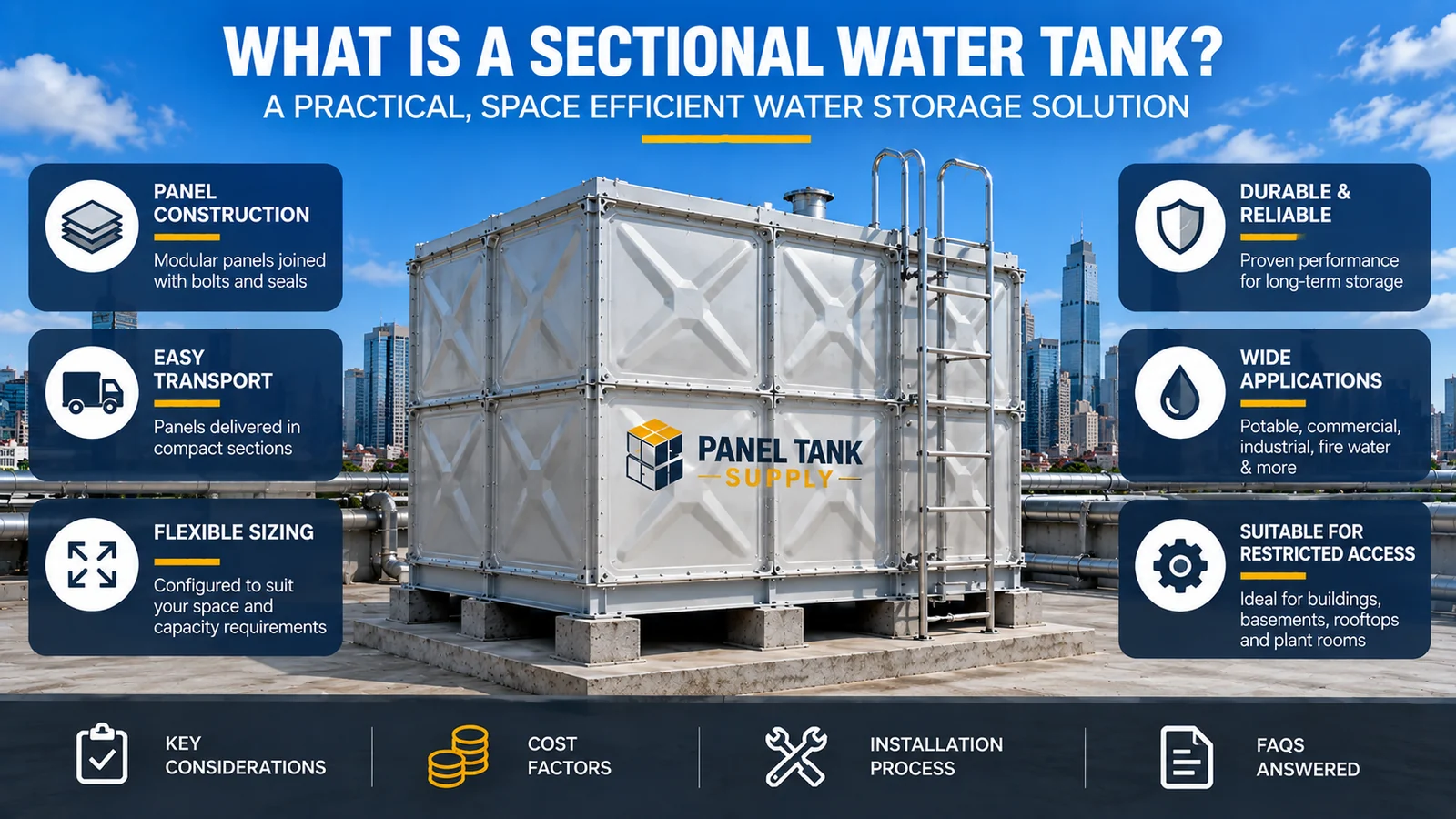
    A sectional water tank is a water-storage system assembled from multiple prefabricated panels or sections rather than being manufactured and delivered as one complete vessel.

    The individual panels are transported to the project site and mechanically assembled to create the required tank capacity and dimensions.

    This makes sectional water tanks particularly useful for commercial buildings, plant rooms, basements, rooftops and other restricted-access locations where a large one-piece tank may be difficult or impossible to move into position.

    Common sectional tank materials include GRP / FRP, stainless steel and galvanized steel.

    This guide explains what a sectional water tank is, how it differs from a one-piece tank, where sectional tanks are used and what buyers should confirm before ordering.

    How Is a Sectional Water Tank Constructed?

    A sectional tank is manufactured as a set of repeatable panels and related structural components.

    Depending on the selected tank system, the complete package can include:

    • Wall panels
    • Floor panels or floor system components
    • Roof panels or covers
    • Bolts and fasteners
    • Seals and gaskets
    • Internal or external reinforcement
    • Structural supports
    • Inlet connections
    • Outlet connections
    • Overflow connections
    • Drain connections
    • Access hatches
    • Ladders
    • Vents
    • Level indication
    • Other project-specific accessories

    The tank components are delivered to the installation site and assembled according to the manufacturer’s design and installation requirements.

    What Is the Main Advantage of a Sectional Tank?

    The biggest practical advantage is that a large finished tank does not have to be transported to the installation location as one piece.

    Instead, the tank arrives in manageable components.

    This can make sectional storage particularly useful where site access is restricted by:

    • Door openings
    • Corridors
    • Elevators
    • Basement access
    • Existing building structures
    • Rooftop lifting restrictions
    • Plant-room layouts
    • Restricted loading areas

    The individual components can be moved to the tank location before the complete structure is assembled.

    Sectional Water Tank vs One-Piece Water Tank

    Consideration Sectional Water Tank One-Piece Tank
    Delivery Delivered as panels and components Delivered largely or completely assembled
    Site access Well suited to restricted access Requires sufficient access for the complete tank
    Size flexibility Can be configured using modular panel arrangements Limited to available manufactured vessel sizes
    Indoor installation Often practical because components are assembled in place Can be difficult for large vessels
    Transport Components can be packed for shipment Large completed tanks may require oversized transport
    Future service Panels, seals and accessories form part of a serviceable modular system Service approach depends on the vessel design
    Material choices GRP / FRP, stainless steel, galvanized steel and other modular systems Varies by manufacturer and vessel type

    The best approach depends on tank capacity, site access, available footprint, material requirements and project constraints.

    Is a Sectional Tank the Same as a Modular Panel Tank?

    The terms are closely related and are sometimes used interchangeably.

    A modular panel water tank is a broad description for tanks built from prefabricated components.

    A sectional water tank commonly refers to rectangular tanks constructed from repeatable wall, floor and roof sections.

    GRP / FRP, stainless steel and galvanized steel systems are commonly described as sectional panel tanks.

    Large circular bolted systems such as glass fused to steel tanks are also modular, but they are not always described as sectional tanks in the same way as rectangular panel systems.

    For a broader explanation, see what is a modular panel water tank?

    What Materials Are Sectional Water Tanks Made From?

    Different sectional materials suit different water-storage requirements.

    GRP / FRP Sectional Tanks

    GRP / FRP tanks use fiberglass-reinforced composite panels assembled into a rectangular modular tank.

    They can be attractive where relatively lightweight components, resistance to conventional steel rust and restricted-access installation are important.

    Explore GRP / FRP panel water tanks.

    Stainless Steel Sectional Tanks

    Stainless sectional tanks use pressed stainless-steel panels assembled into the required tank configuration.

    Stainless steel can provide a durable, cleanable surface for potable-water, process-water and commercial-building applications where the selected grade is suitable for the service and environment.

    Common grades can include 304 and 316L.

    Explore stainless steel panel water tanks.

    Galvanized Steel Sectional Tanks

    Galvanized sectional tanks use pressed steel panels protected by a galvanized zinc coating.

    The external-flanged modular format is commonly considered for fire water, commercial building services, factory water and other general utility applications.

    Explore galvanized steel panel water tanks.

    Where Are Sectional Water Tanks Used?

    Sectional tanks can be used for a broad range of commercial and industrial water-storage applications.

    Commercial Building Water Storage

    Commercial buildings may require stored water for domestic services, building systems, emergency storage or other applications.

    Sectional construction can be particularly useful where the available plant-room dimensions are known but the access route is too small for a complete tank.

    See commercial building water tanks.

    Fire Water Storage

    Sectional tanks can be used for dedicated fire-protection water storage when the tank system meets the requirements of the project design.

    The required usable storage volume should be established from the fire-protection design before selecting the tank configuration.

    See fire water storage tanks.

    Potable Water Storage

    Sectional tanks may also be used for drinking-water storage where the specific system and wetted materials meet the required project and certification requirements.

    Material suitability should be confirmed for the actual supplied system.

    See potable water storage tanks.

    Industrial Water Storage

    Industrial facilities may use sectional tanks for process water, utility water, factory water, washdown water, raw water or other general storage duties.

    The stored liquid, water chemistry, temperature and operating environment should influence material selection.

    See industrial water storage tanks.

    Why Are Sectional Tanks Useful Inside Existing Buildings?

    Existing buildings are one of the strongest applications for sectional tank construction.

    A building may contain enough floor area for the required tank but still have no access route large enough for a complete vessel.

    For example, a tank may need to be installed:

    • Inside a basement plant room
    • Behind existing walls
    • Inside a high-rise mechanical floor
    • On a rooftop
    • Inside a hospital plant area
    • Inside a hotel mechanical room
    • Inside an existing factory

    Because the tank arrives in separate components, the panels can potentially pass through the available route before assembly.

    The access route still needs to be surveyed carefully. Panel dimensions, component weights, turning space, lifting requirements and working clearance all matter.

    Can a Sectional Tank Be Built to Fit a Specific Space?

    One of the benefits of sectional construction is dimensional flexibility.

    The tank configuration can often be developed around:

    • Required capacity
    • Available length
    • Available width
    • Maximum height
    • Panel dimensions
    • Structural requirements
    • Connection locations
    • Assembly clearance

    This means the same required capacity may sometimes be achieved using different tank proportions.

    For example, one project may favor a lower, wider tank while another may require a narrower, taller configuration.

    However, dimensional flexibility has structural limits. The final configuration needs to be engineered for the selected tank system.

    How Is a Sectional Water Tank Delivered?

    A sectional tank is normally shipped as a package of panels and related components rather than as one complete oversized vessel.

    This can simplify transportation and make long-distance delivery more practical.

    Freight planning should consider:

    • Project ZIP code and state
    • Package sizes
    • Package weights
    • Delivery vehicle access
    • Site unloading
    • Temporary storage
    • Protection of tank components before assembly

    Providing the project location during the quotation stage helps establish the expected freight scope.

    How Is a Sectional Water Tank Installed?

    The installation sequence depends on the selected tank system.

    At a high level, the process can include:

    1. Confirming the supporting structure is ready
    2. Receiving and checking the tank components
    3. Organizing panels and structural components
    4. Assembling the floor or base arrangement
    5. Installing wall panels
    6. Installing reinforcement or bracing
    7. Completing roof components
    8. Installing connections and accessories
    9. Checking seals, fasteners and alignment
    10. Completing the required inspection and commissioning process

    The actual installation should follow the documentation supplied for the selected tank system.

    How Much Clearance Is Needed Around a Sectional Tank?

    There is no single clearance dimension that applies to every system.

    Working space may be required for:

    • Panel assembly
    • Fastener access
    • Structural bracing
    • Roof assembly
    • Pipe connections
    • Inspection
    • Future maintenance

    Before ordering, provide the available tank-room dimensions and any fixed obstacles around the proposed tank location.

    What Foundation Does a Sectional Tank Need?

    A sectional tank requires a suitable supporting structure capable of carrying the filled operating load.

    The exact support geometry depends on the tank material and design.

    Important considerations can include:

    • Tank weight when full
    • Support spacing
    • Levelness
    • Tank flange or base support requirements
    • Concrete or steel support structure
    • Anchorage where required
    • Wind loading
    • Seismic criteria

    The support arrangement should be confirmed for the actual tank rather than assuming one foundation detail is suitable for every sectional system.

    What Connections Are Required?

    Most sectional tanks require several connections that should be coordinated before manufacture.

    These can include:

    • Inlet
    • Outlet
    • Overflow
    • Drain
    • Fire suction connection
    • Return connection
    • Level instrumentation
    • Special process fittings

    Connection requirements should include size, position and any relevant flange or fitting standard.

    Pipework should be supported appropriately so excessive external loads are not transferred into the tank connection.

    Can Sectional Tanks Have Compartments?

    Some sectional systems can be configured with compartmentation where the selected design supports it.

    Compartments may be useful where a project requires operational redundancy or needs part of the tank to remain available while another section is inspected or maintained.

    The required compartment arrangement should be identified during the design and quotation stage.

    Are Sectional Water Tanks Easy to Maintain?

    The modular nature of a sectional tank can provide a serviceable system, but maintenance is still required.

    Inspection may include:

    • Panels
    • Panel joints
    • Seals and gaskets
    • Bolts and fasteners
    • Internal reinforcement
    • External supports
    • Roof components
    • Access equipment
    • Pipe connections
    • Overflow and drain arrangements

    The inspection and maintenance program should follow the requirements applicable to the exact tank system and water service.

    How Long Does a Sectional Water Tank Last?

    There is no one service-life figure that applies to every sectional tank.

    Longevity depends on factors such as:

    • Tank material
    • Water chemistry
    • External environment
    • Installation quality
    • Structural loading
    • Seal condition
    • Coating condition where applicable
    • Inspection and maintenance

    Material should therefore be selected for the actual project conditions rather than from a generic lifespan claim.

    How Much Does a Sectional Water Tank Cost?

    There is no universal price for a sectional tank because the complete tank package changes from project to project.

    Cost can be influenced by:

    • Tank material
    • Storage capacity
    • Tank dimensions
    • Tank height
    • Panel configuration
    • Structural reinforcement
    • Roof type
    • Connection sizes
    • Accessories
    • Certification requirements
    • Project documentation
    • Freight destination

    Two sectional tanks with the same capacity can have different prices if their geometry or specifications are different.

    Sectional vs Modular: Which Term Should You Use?

    For many rectangular panel-tank projects, either term may appear during procurement.

    If you are searching for suppliers, useful terms include:

    • Sectional water tank
    • Panel water tank
    • Modular water tank
    • Sectional panel tank
    • GRP sectional tank
    • Stainless steel sectional tank
    • Galvanized sectional tank

    What matters most is not the terminology but whether the proposed system meets the project requirements.

    What Information Should You Provide for a Quote?

    A useful quotation should start with a clear project brief.

    Provide:

    • Required usable capacity
    • Stored water or liquid
    • Project ZIP code and state
    • Available tank length
    • Available tank width
    • Maximum tank height
    • Indoor or outdoor installation
    • Access restrictions
    • Inlet requirements
    • Outlet requirements
    • Overflow requirements
    • Drain requirements
    • Required accessories
    • Foundation or support information where available
    • Applicable standards
    • Required certifications
    • Project drawings
    • Required delivery date

    What Is a Sectional Water Tank? Final Answer

    A sectional water tank is a storage tank assembled from multiple prefabricated panels or sections at the project site.

    The sectional approach allows large tanks to be transported in manageable components, configured around available space and installed in locations where moving a complete one-piece tank would be difficult.

    Common sectional systems include GRP / FRP, stainless steel and galvanized steel panel tanks.

    They can be used for commercial building water, potable water, fire water, process water and other industrial applications when the selected system is suitable for the project.

    For successful procurement, confirm the required capacity, material, available dimensions, site access, foundation, connections, environmental conditions and project specifications before ordering.


    Need a Sectional Water Tank for Your Project?

    Panel Tank Supply can review your project requirements and help identify an appropriate sectional tank system for quotation.

    Send us your required capacity, water application, project ZIP code and state, available tank dimensions, access restrictions, connection requirements and any drawings or specifications.

    Request a Sectional Water Tank Quote →


    Frequently Asked Questions

    What Is a Sectional Water Tank?

    A sectional water tank is assembled from individual prefabricated panels or sections at the installation site rather than being supplied as one complete vessel.

    What Is the Difference Between a Sectional Tank and a One-Piece Tank?

    A sectional tank arrives as separate components for site assembly, while a one-piece tank is largely or completely manufactured before delivery. Sectional construction can make large tanks easier to install in restricted-access areas.

    Is a Sectional Tank the Same as a Panel Tank?

    In many water-storage applications the terms overlap. Sectional tanks are commonly built from modular panels, so they are frequently described as sectional panel tanks or simply panel tanks.

    What Materials Are Sectional Water Tanks Available In?

    Common materials include GRP / FRP, stainless steel and galvanized steel. Each material has different corrosion, weight, hygiene, cost and environmental considerations.

    Can a Sectional Tank Be Installed in a Basement?

    Potentially yes. The ability to transport individual components through restricted routes makes sectional construction useful for basements and plant rooms, subject to sufficient panel access and working clearance.

    Can Sectional Water Tanks Be Installed on Rooftops?

    They can be used for rooftop projects where the structure, access, lifting plan, wind requirements and other project conditions are suitable for the selected tank system.

    Can Sectional Tanks Store Potable Water?

    Potentially. Potable-water suitability depends on the exact tank system, wetted materials and required certifications rather than sectional construction alone.

    Can Sectional Tanks Be Used for Fire Water?

    Yes, suitable sectional tank systems can be used for dedicated fire-water storage. The required usable capacity and hydraulic arrangement should be established from the project fire-protection design.

    Can a Sectional Tank Be Customized to Fit a Plant Room?

    Sectional construction provides dimensional flexibility, and tank configurations can often be developed around the available footprint and height. The final arrangement must remain within the structural limits of the selected system.

    What Information Is Needed for a Sectional Tank Quote?

    Provide the required capacity, stored service, project location, available dimensions, access limitations, connection schedule, foundation information where available and any relevant project drawings or specifications.
  • What Is a Modular Panel Water Tank? A Complete Buyer’s Guide

    What Is a Modular Panel Water Tank? A Complete Buyer’s Guide

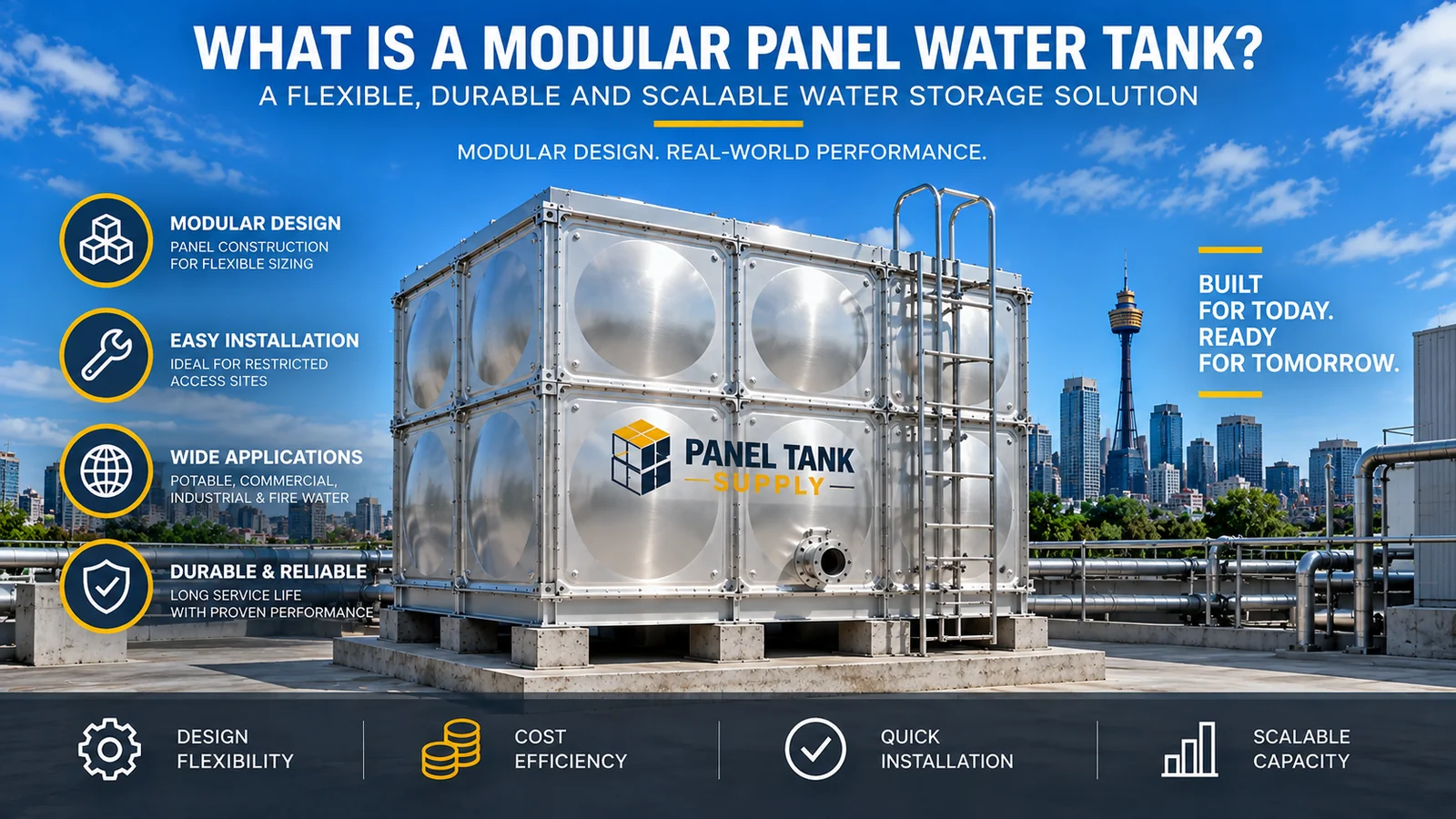
    A modular panel water tank is a water-storage system built from individual factory-made panels and components that are transported to the project site and assembled into the final tank.

    Instead of manufacturing and delivering one complete oversized vessel, the tank arrives in modular sections. The panels are bolted or mechanically joined together on site to create the required capacity, footprint and height.

    This construction method makes modular panel water tanks particularly useful for commercial buildings, industrial facilities, fire-water systems, potable-water projects and restricted-access locations where transporting a complete tank into position would be difficult or impossible.

    Panel systems are available in several materials, including GRP / FRP, stainless steel, galvanized steel and glass fused to steel.

    This guide explains how modular panel tanks work, why they are used, what materials are available and what information buyers should provide before requesting a quotation.

    How Does a Modular Panel Water Tank Work?

    The basic concept is straightforward.

    Instead of one large fabricated shell, the water tank is divided into repeatable structural components.

    Depending on the tank system, the package may include:

    • Tank panels
    • Structural reinforcement
    • Roof components
    • Bolts and fasteners
    • Seals and gaskets
    • Bracing
    • Inlet connections
    • Outlet connections
    • Overflow connections
    • Drain connections
    • Access hatches
    • Ladders
    • Platforms where required
    • Vents
    • Level-indication components
    • Drawings
    • Installation information

    The components are delivered to the project location and assembled according to the selected tank system and project design.

    Once assembled, the individual panels work together to form the complete water-storage structure.

    Why Use Panels Instead of One Large Tank?

    One of the biggest advantages of panel construction is logistics.

    A large completed tank may be difficult to manufacture, transport and move into its final location as one piece.

    There may be restrictions such as:

    • Road transport dimensions
    • Building entrances
    • Door widths
    • Elevator dimensions
    • Service corridors
    • Plant-room access
    • Rooftop lifting limitations
    • Existing building structures

    A modular system divides the tank into smaller components that can be shipped efficiently and moved individually through the available access route.

    The final storage tank can then be assembled at the location where it will operate.

    What Is a Sectional Water Tank?

    The terms sectional water tank and modular panel water tank are closely related.

    A sectional tank is assembled from multiple sections or panels rather than being manufactured as one complete vessel.

    The term is particularly common for rectangular GRP, stainless steel and galvanized steel tanks used in commercial buildings, fire protection and industrial applications.

    Large bolted steel systems such as glass fused to steel tanks also use modular prefabricated construction, although their geometry and panel system may differ from traditional rectangular sectional tanks.

    Common Modular Panel Tank Materials

    There is no single material that is automatically best for every modular water-storage project.

    Material selection depends on stored water, corrosion exposure, capacity, installation environment, access, project specification, maintenance expectations and budget.

    GRP / FRP Panel Tanks

    GRP, FRP and fiberglass terminology is commonly used for composite panel water tanks.

    These systems use molded fiberglass-reinforced panels that are assembled into the required tank configuration.

    GRP / FRP can be attractive where lightweight modular components, resistance to conventional steel rust and restricted-access installation are important.

    Explore GRP / FRP panel water tanks.

    Stainless Steel Panel Tanks

    Stainless steel sectional tanks use pressed stainless panels assembled into a modular tank.

    They may be considered where cleanability, durability and corrosion performance are important design factors.

    Common stainless grades can include 304 and 316L, with the appropriate grade selected according to the stored service and environment.

    Explore stainless steel panel water tanks.

    Galvanized Steel Panel Tanks

    Galvanized sectional tanks use pressed steel panels protected by a galvanized zinc coating.

    The modular external-flanged format can be suitable for fire water, commercial building services, factory water and other general water-storage duties when the system matches the application.

    Explore galvanized steel panel water tanks.

    Glass Fused to Steel Tanks

    Glass fused to steel, or GFS, uses factory-coated steel panels with a vitrified glass-based coating bonded to the steel.

    GFS systems are commonly supplied as bolted circular tanks and can be particularly useful for larger-capacity municipal, industrial, process-water and wastewater applications.

    Explore glass fused to steel bolted tanks.

    Modular Panel Tank Materials: Quick Comparison

    Material Typical Construction Key Considerations
    GRP / FRP Molded fiberglass-reinforced sectional panels Lightweight handling, corrosion behavior, resin specification and water-service requirements
    Stainless Steel Pressed stainless steel sectional panels Grade selection, chloride exposure, hygiene and environment
    Galvanized Steel Pressed steel sectional panels with galvanized protection Water service, external exposure, support geometry and coating condition
    Glass Fused to Steel Factory-coated bolted steel panels Large-capacity storage, coating specification, process duty and project design

    Can Modular Panel Tanks Be Made to Different Sizes?

    Yes. One of the main advantages of modular construction is the ability to configure the tank around project requirements.

    The required capacity can often be achieved through different combinations of:

    • Tank length
    • Tank width
    • Tank diameter for relevant systems
    • Tank height
    • Panel arrangement
    • Compartmentation where supported by the selected system

    This flexibility can be valuable when a project has a fixed plant-room footprint or height limitation.

    However, not every dimension is interchangeable.

    Tank height, geometry and panel arrangement affect structural loading and may influence panel thickness, reinforcement and foundation requirements.

    How Is Tank Capacity Determined?

    Tank capacity should begin with the actual water-storage requirement rather than simply choosing the largest tank that fits the available space.

    The designer or project team should establish the required usable volume for the application.

    The required capacity may depend on factors such as:

    • Building water demand
    • Fire-protection design
    • Process-water requirements
    • Emergency reserve
    • Municipal or utility storage requirements
    • Operating water level
    • Required freeboard
    • Compartmentation

    Once the required volume is known, a tank configuration can be developed around the available footprint and height.

    Where Are Modular Panel Water Tanks Used?

    Modular water tanks can be used across a broad range of building, commercial, industrial and infrastructure applications.

    Commercial Buildings

    Hotels, hospitals, apartment buildings, schools, offices and high-rise developments may require water storage inside mechanical rooms, basements, rooftops or dedicated tank rooms.

    Sectional construction can help where available access prevents the installation of a complete one-piece vessel.

    See commercial building water tanks.

    Potable Water

    Modular tanks may be used for drinking-water storage when the specific tank system, wetted materials and applicable certifications are suitable for the application.

    See potable water storage tanks.

    Fire Water

    Panel tanks are also widely considered for dedicated fire-protection water storage.

    The required usable fire-water capacity and hydraulic arrangement should be established from the fire-protection design before the tank is selected.

    See fire water storage tanks.

    Industrial Water

    Manufacturing facilities and industrial sites may use modular tanks for process water, utility water, washdown water, raw water and other storage duties.

    The stored liquid and operating environment should guide material and coating selection.

    See industrial water storage tanks.

    Municipal and Infrastructure Storage

    Larger bolted systems may also be considered for municipal, infrastructure and utility projects requiring substantial storage capacities.

    See municipal water storage tanks.

    Why Modular Tanks Work Well for Restricted Access

    Restricted access is one of the strongest reasons to consider a sectional water tank.

    Imagine a large mechanical room inside an existing building.

    The room may have enough space for a 20,000-gallon water tank, but there may be no way to move a complete 20,000-gallon vessel through the building.

    A modular tank approaches the problem differently.

    The panels and structural components are transported through the available route individually and the tank is assembled inside the final location.

    This can make modular construction useful for:

    • Basements
    • Rooftops
    • High-rise plant rooms
    • Mechanical rooms
    • Existing buildings
    • Replacement tank projects
    • Sites with restricted crane access
    • Locations with narrow delivery routes

    How Are Modular Panel Tanks Shipped?

    Because the completed tank is divided into individual panels and components, modular systems can be packaged for transportation instead of moving one oversized vessel.

    The exact package depends on tank material and configuration.

    Project freight planning should consider:

    • Project ZIP code and state
    • Package dimensions
    • Package weight
    • Site unloading arrangements
    • Delivery access
    • Storage before assembly
    • Lifting equipment

    For US projects, providing the delivery ZIP code during quotation helps establish realistic freight requirements.

    How Is a Modular Panel Tank Installed?

    The exact installation sequence varies by tank type, but the general process involves preparing the supporting structure, receiving and organizing the tank components, assembling the panels and structural system, installing connections and accessories, and completing the checks required for the selected system.

    Tank assembly should follow the installation documentation applicable to the specific product.

    The foundation or supporting structure should also be ready and suitable before tank assembly begins.

    What Foundation Does a Panel Water Tank Need?

    Foundation requirements vary with tank material, geometry, capacity and structural arrangement.

    There is no single foundation detail that should be copied across every panel tank.

    The support system needs to accommodate the full operating load of the tank and provide the geometry required by the selected tank design.

    Relevant considerations can include:

    • Tank reactions
    • Filled operating weight
    • Support spacing
    • Levelness
    • Concrete or structural steel supports
    • Wind loads
    • Seismic requirements
    • Anchorage where required

    The required support information should be confirmed for the actual tank configuration.

    What Connections Does a Modular Water Tank Need?

    A tank normally requires several hydraulic and service connections.

    Depending on the project, these may include:

    • Inlet
    • Outlet
    • Overflow
    • Drain
    • Fire suction
    • Return connection
    • Level instrumentation
    • Specialist process nozzles

    Connection size, location, elevation and orientation should be coordinated before manufacture whenever possible.

    Late changes can affect panels, reinforcement or project schedule.

    What Accessories Can Be Included?

    Depending on the selected tank system and project requirements, accessories can include:

    • Access hatches
    • Internal or external ladders
    • Platforms
    • Handrails
    • Vents
    • Level indicators
    • Insulation
    • Roof penetrations
    • Special fittings
    • Other project-specific components

    The required accessories should be identified early so they can be coordinated with the tank design.

    What Is Included in a Supply-Only Modular Tank Package?

    Panel Tank Supply operates around a supply-only modular tank model.

    The exact scope depends on the selected system and quotation, but a tank package may include panels, structural components, roof components, bracing, bolts, seals, fittings, access components, drawings and installation information.

    The project team should review the quotation carefully so there is a clear understanding of what is included and what remains within the installer, contractor or project team’s scope.

    How Much Does a Modular Panel Water Tank Cost?

    There is no reliable single price per gallon for every modular water tank.

    Two tanks with the same capacity can have different costs because their geometry, material, structural requirements and accessories are different.

    Important pricing factors include:

    • Tank material
    • Required capacity
    • Tank height
    • Tank footprint
    • Panel configuration
    • Structural reinforcement
    • Roof design
    • Connection sizes
    • Accessories
    • Coating requirements
    • Documentation
    • Project location
    • Freight

    A useful quotation therefore requires actual project information rather than capacity alone.

    What Information Should You Provide for a Quote?

    The more complete the project brief, the easier it is to compare appropriate tank systems.

    Provide:

    • Required storage capacity
    • Intended application
    • Stored water or liquid
    • Project ZIP code and state
    • Available length and width
    • Maximum available height
    • Indoor or outdoor installation
    • Access restrictions
    • Inlet size and location
    • Outlet size and location
    • Overflow requirements
    • Drain requirements
    • Required accessories
    • Applicable project standards
    • Required certifications
    • Project drawings and specifications
    • Required delivery date

    Advantages of Modular Panel Water Tanks

    Modular panel tanks can offer several practical advantages when matched correctly to the project.

    • Large storage capacity can be delivered as smaller components
    • Useful for restricted-access installations
    • Multiple material systems are available
    • Tank dimensions can be coordinated around available space
    • Components can be manufactured before site assembly
    • Connections and accessories can be coordinated with the project
    • Individual components form part of a serviceable modular system
    • Suitable for commercial, industrial, potable, fire-water and infrastructure applications depending on the selected system

    What Are the Limitations?

    Modular construction does not eliminate the need for proper engineering and project coordination.

    A panel tank still requires:

    • A suitable supporting structure
    • Correct structural design
    • Sufficient assembly clearance
    • Appropriate installation procedures
    • Correct material selection
    • Coordinated pipe connections
    • Inspection and maintenance

    The tank should therefore be treated as an engineered storage system rather than simply a collection of interchangeable panels.

    What Is a Modular Panel Water Tank? Final Answer

    A modular panel water tank is a water-storage tank manufactured from prefabricated panels and structural components that are transported to site and assembled into the final tank.

    The modular approach allows substantial storage capacities to be delivered efficiently, configured around available space and installed in locations where a complete one-piece vessel may be impractical.

    Common systems include GRP / FRP, stainless steel, galvanized steel and glass fused to steel.

    The correct tank depends on the required capacity, water service, project environment, access, available dimensions, structural requirements, connections, certifications and budget.

    For procurement, start with the project requirements first and then select the tank material and configuration that best match those requirements.


    Need a Modular Panel Water Tank for Your Project?

    Panel Tank Supply can review your project requirements and identify suitable modular tank systems for quotation.

    Send the required capacity, application, project ZIP code and state, available dimensions, connection requirements, required delivery date and any relevant drawings or specifications.

    Request a Modular Panel Water Tank Quote →


    Frequently Asked Questions

    What Is a Modular Panel Water Tank?

    A modular panel water tank is assembled from factory-made panels and structural components rather than being manufactured and delivered as one complete vessel. The components are transported to site and assembled into the final tank configuration.

    Is a Modular Tank the Same as a Sectional Tank?

    The terms are closely related. Sectional water tanks are a type of modular tank constructed from multiple panels or sections. The term is commonly used for rectangular GRP, stainless steel and galvanized steel systems.

    What Materials Are Modular Water Tanks Made From?

    Common modular systems include GRP / FRP, stainless steel, galvanized steel and glass fused to steel. The appropriate material depends on the stored water, environment, capacity, project specification and other design requirements.

    Can a Modular Water Tank Be Installed Inside a Building?

    Yes. Sectional construction can be particularly useful inside existing buildings because the tank components can be transported separately through the available access route and assembled at the final location.

    Can Modular Tanks Store Potable Water?

    Potentially. Potable-water suitability depends on the specific tank system, wetted materials and required product certification. These requirements should be confirmed for the exact system being supplied.

    Can Modular Panel Tanks Be Used for Fire Water?

    Yes, suitable modular tank systems can be used for fire-water storage. The required usable capacity and hydraulic arrangement should be established by the fire-protection design before tank selection.

    Are Modular Water Tanks Available in Custom Sizes?

    Panelized construction allows tank configurations to be developed around a range of capacities and site dimensions, subject to the structural and dimensional limits of the selected system.

    How Are Modular Water Tanks Delivered?

    The tank is supplied as panels and related components rather than one complete oversized vessel. The package is transported to the project site for assembly.

    What Information Is Needed for a Tank Quote?

    Provide the required capacity, application, project location, available dimensions, stored water or liquid, access constraints, connection requirements, required accessories and any applicable drawings or specifications.